The short version
- Most sites missed by AI tools have two or three fixable problems, not one mystery cause.
- Check crawler access and indexing first: AI tools can't mention pages they can't reach.
- Say plainly what you do, for whom and where, and answer buyer questions directly on your pages.
- Third-party mentions (reviews, directories, roundups) carry a lot of weight in AI recommendations.
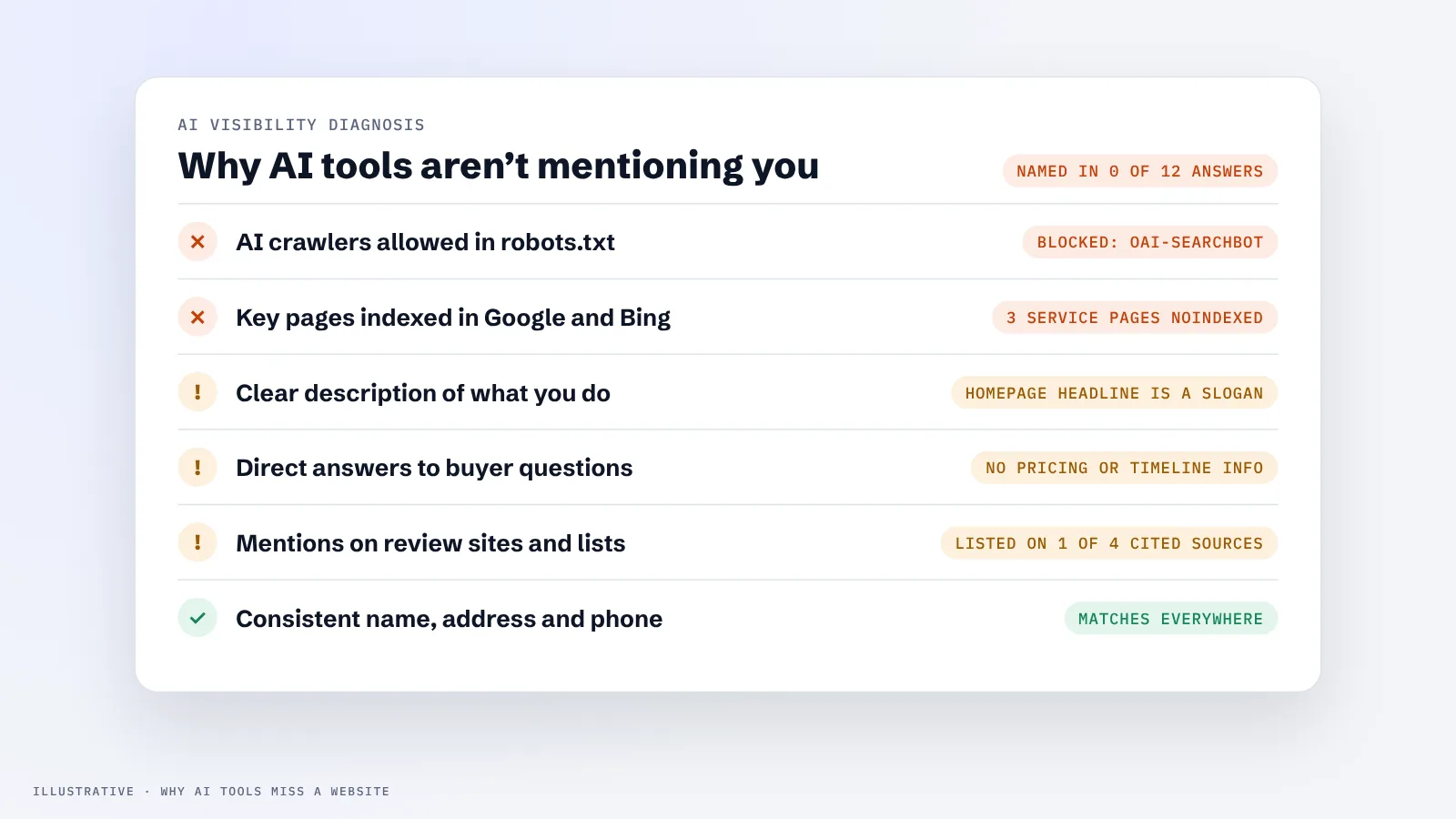
If ChatGPT, Perplexity, Gemini or Google AI Overviews never mention your business, the cause is usually one of a short list: the tools can't reach your pages, they can't tell what your business is, your pages don't answer the question being asked, or nobody else on the web talks about you.
Most sites have two or three of these problems at once. The good news is that each one can be checked in an afternoon and fixed with ordinary SEO work.
This guide walks through the eight reasons we see most often when we run AI visibility checks for businesses, how to test for each one, and what to fix first. If you are new to the terms, our glossary covers AEO, GEO and AI citations in plain English.
First, check whether you are really invisible
Before fixing anything, confirm the problem. AI answers change with the wording of the prompt, the user's location, their chat history and the day you ask. One bad answer on your own laptop proves very little.
Run a quick baseline instead:
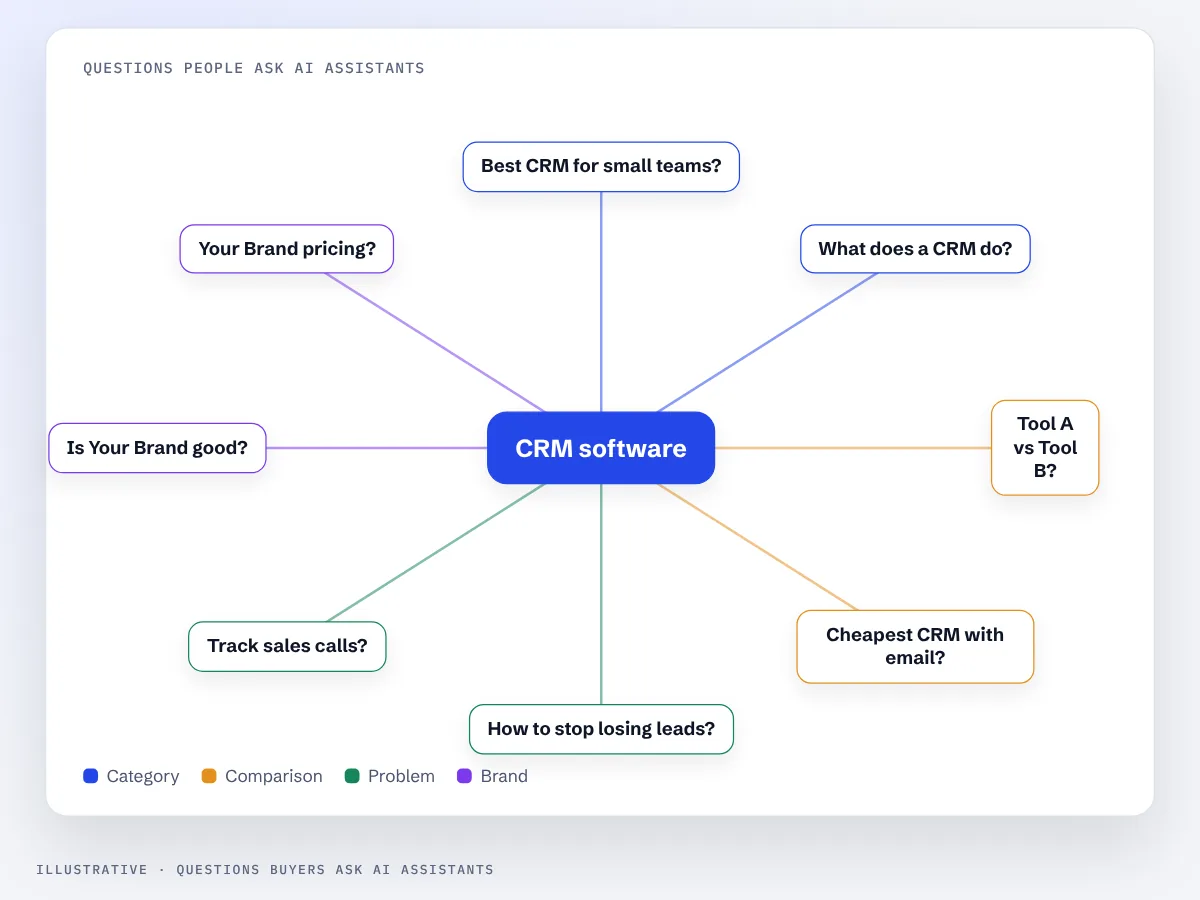
- Write down five to ten questions a real buyer would ask, in their words. "Best physical therapist in Denver for back pain" is a buyer question. "Physical therapy services" is a keyword.
- Ask each question in ChatGPT, Perplexity, Gemini and Google (watch for an AI Overview at the top of the results).
- Use a fresh session: signed out, or a private window, with the location set to the market you sell in.
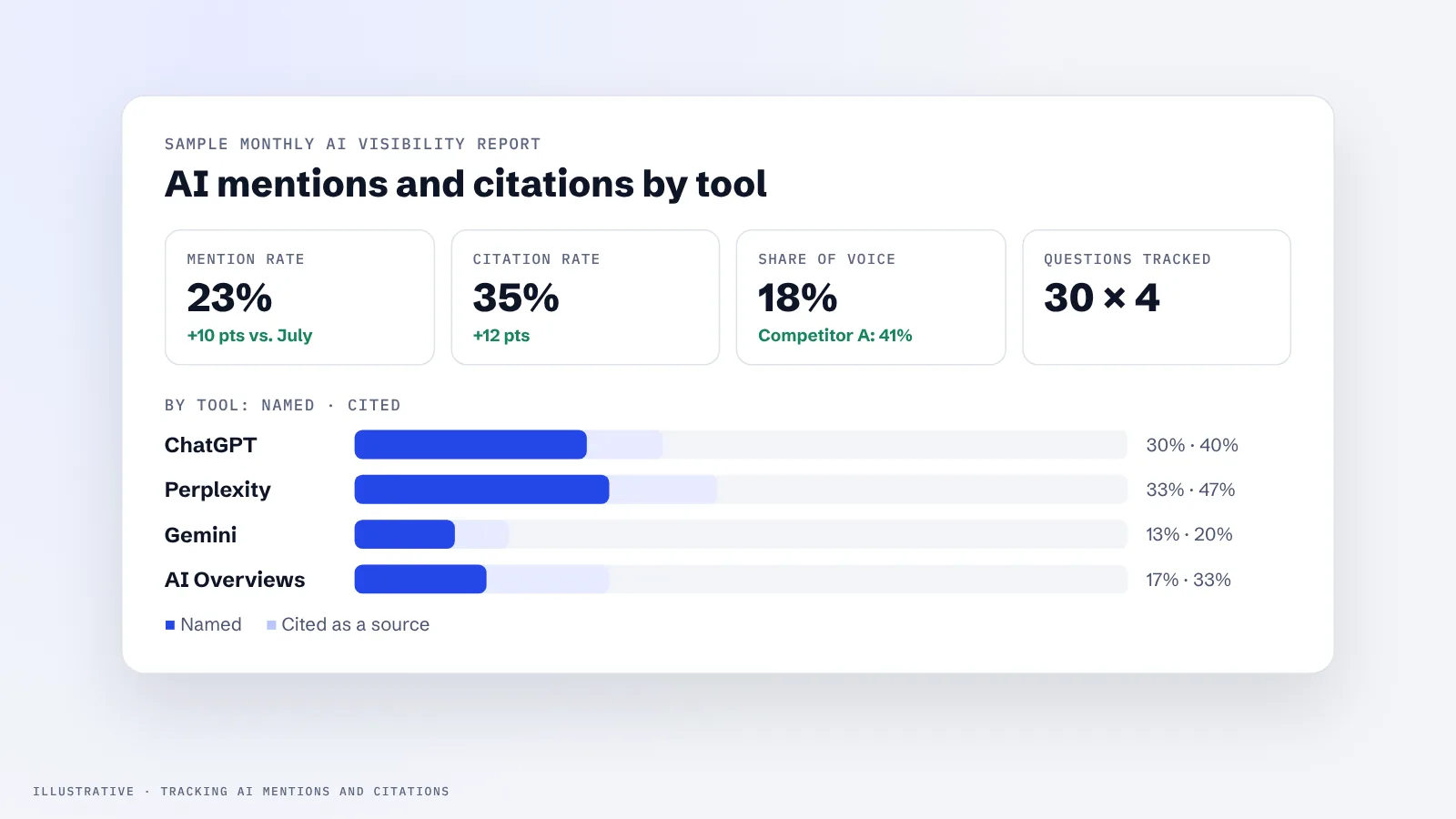
- For each answer, note three things: were you named, was your website cited as a source, and who was named instead.
Keep this in a spreadsheet. It becomes your before-and-after record, and our guide on how to measure AI search visibility explains how to turn it into a monthly report.
Two patterns are worth separating early. If you are cited but not named (your page shows up as a source, but the answer recommends other businesses), the tools can read your site and the problem is trust or positioning. If you are neither named nor cited, start with access and indexing.
Reason 1: AI crawlers can't reach your pages
This is the most common technical cause, and often nobody on the team knows it is happening. AI search tools use their own crawlers, and a robots.txt rule, a firewall setting or a security plugin can quietly block them.
The crawlers to know about:
| User agent | Who runs it | What blocking it affects |
|---|---|---|
| OAI-SearchBot | OpenAI | Whether your pages can appear in ChatGPT search results |
| GPTBot | OpenAI | Use of your content for training OpenAI models |
| PerplexityBot | Perplexity | Whether Perplexity can index and cite your pages |
| Google-Extended | Use of your content for Gemini models. It does not affect Google Search or AI Overviews | |
| Googlebot and Bingbot | Google, Microsoft | Normal search indexing, which AI Overviews, AI Mode and Copilot depend on |
How to check:
- Open
yourdomain.com/robots.txtand look forDisallow: /under any of the agents above, or underUser-agent: *. - Ask whoever manages your CDN or firewall whether "AI bot" or "bot fight" settings are on. Some providers, Cloudflare included, now offer one-click blocking of AI crawlers, and on some newer accounts it is switched on by default.
- Check your server logs for requests from these user agents. No visits at all over a month is a strong hint something is blocking them.
The fix is usually a few lines. Our free AI crawler robots.txt generator lets you allow search crawlers while still opting out of training if you prefer. That split is a business decision, and it is a reasonable one: many companies allow OAI-SearchBot and PerplexityBot but block GPTBot.
Reason 2: Your key pages aren't indexed or render poorly
Google has said there are no special requirements for AI Overviews beyond normal SEO: a page has to be indexed and eligible to show a snippet. The same logic applies elsewhere. If a page is missing from Google's or Bing's index, AI tools that build on those indexes are unlikely to use it.
Common culprits we find:
- Service pages tagged
noindexduring a redesign and never switched back. - Important content loaded only by JavaScript, so a crawler that doesn't run scripts sees an almost empty page.
- Canonical tags pointing to the wrong URL, so the page you care about is treated as a duplicate.
- Thin location or service pages that Google crawls but chooses not to index.
Use the Pages report and URL Inspection in Google Search Console, and set up Bing Webmaster Tools if you haven't, since Copilot draws on Bing's index. For a deeper check of rendering, redirects and indexing, see our technical SEO services or the checklist in our technical SEO audit priorities article.
Reason 3: AI tools can't tell what your business does
AI tools build an understanding of a business as an entity: a name connected to a category, services, a location, people and reviews. When that picture is fuzzy, the tool plays it safe and names businesses it understands better.
Signs of a fuzzy entity:
- Your homepage headline is a slogan ("Building better tomorrows") and never says what you sell or where.
- Your business name, address and phone number differ between your site, Google Business Profile and directories.
- The About page says little about who runs the business, how long it has operated or who it serves.
- Ask ChatGPT "What does [your business name] do?" and it guesses, mixes you up with another company or says it doesn't know.
Fixes are mostly writing and consistency. Say plainly what you do, for whom and where, on the homepage and About page. Keep business details identical everywhere. Add Organization and LocalBusiness schema markup that matches the visible page. None of this is glamorous, and it is often what moves a business from "doesn't know you" to an accurate description.
Reason 4: Your pages don't answer the questions people ask
AI answers are assembled from passages that answer the question directly. A service page that lists features but never answers "how much does it cost", "how long does it take" or "is it right for a company my size" gives the tool nothing to quote.
Compare two versions of the same page for a commercial roofing company:
| Hard to quote | Easy to quote |
|---|---|
| "We deliver industry-leading roofing solutions with a commitment to excellence." | "A commercial roof inspection takes two to three hours for a typical warehouse and includes a photo report within 48 hours." |
| A single long page with no subheadings | Short sections under headings that match real questions |
| Prices and timelines left out entirely | Typical price ranges and what changes them |
A practical approach: take your buyer question list and check whether each question has a clear, two-to-four sentence answer somewhere on your site. Where it doesn't, add a section to the relevant page or write a dedicated guide. FAQ sections still help here. Google limited FAQ rich results to government and health sites in 2023, but the questions and answers on the page are still useful to readers and to AI tools. Our FAQ schema generator helps if you want the markup too.
For a step-by-step version of this, read how to get cited in ChatGPT and AI Overviews.
Reason 5: Nobody else mentions you
This is the reason businesses most often underestimate. When an AI tool recommends companies, it leans heavily on what other sites say: review platforms, "best of" lists, industry directories, news coverage, forums and comparison articles. If your business appears only on your own website, you are asking the tool to take your word for it.
When we look at the sources AI answers cite for local and B2B questions, the same types keep coming up: review sites, local or industry roundups, Reddit threads and directories. Check which sources the answers in your baseline cite, then ask:
- Are we listed on the review and directory sites these answers rely on?
- Do we have recent reviews there, and do we respond to them?
- Are we included in the roundups and comparison articles that keep getting cited? If not, is there a reason a writer would add us?
- Do people in our industry forums ever mention us, and do we take part in those conversations in good faith?
This is slow work and can't be faked. Paid placements and review swaps tend to backfire. Real customers leaving reviews, useful contributions to industry sites and being worth including in a roundup are what build the kind of mentions AI tools pick up.
Reason 6: Competitors already own the sources AI trusts
Sometimes your site is fine and the answer still names three competitors. Look at the sources cited next to their names. Often one competitor wrote the detailed guide that every answer quotes, or sits at the top of the review site the tools rely on.
That tells you where to compete. If the cited guide is thin or out of date, publish a better one with real detail from your own work. If the review site drives the answer, focus on earning reviews there. If a comparison article keeps appearing, contact the author with information that would improve it. You won't win every question, so pick the ones closest to revenue.
Reason 7: Your content is old, thin or generic
AI tools tend to prefer pages that show specific, first-hand knowledge. A 400-word page that could describe any company in your industry gives them little reason to pick you. The same goes for pages with outdated prices, discontinued services or a copyright year from five years ago.
Signals that help: named authors with real experience, specific examples from your own work, clear dates on time-sensitive content, and pages that cover a topic properly instead of skimming it. These are the same E-E-A-T signals Google's own guidance talks about, and they carry over to answer engines.
Reason 8: You're testing the wrong questions
Last, check your own test. Businesses often search for their exact service name, see nothing, and assume they are invisible. Buyers rarely ask that way. They ask longer questions with context: budget, location, team size, a problem they are trying to solve.
A B2B software company might be absent for "project management software" (a huge, crowded category) and still be recommended for "project management tool for agencies that need client approval workflows". The second question is closer to what their best customers ask. Build your test list from sales calls and support tickets, and you will get a truer picture.
What to fix first
Work in this order. Each step makes the next one count.
- Access. Make sure search and AI crawlers can reach and render your key pages.
- Indexing. Confirm your main service, product and location pages are indexed in Google and Bing.
- Identity. Say clearly what you do, for whom and where. Keep business details consistent everywhere.
- Answers. Add direct answers to the questions on your list, on the pages where they belong.
- Mentions. Work on reviews, directories and the third-party sources that answers in your market cite.
- Tracking. Rerun the same questions every month and record what changed.
Steps one to three can often be done in a few weeks. Steps four and five take months. That's normal. If you want a team to handle it, our AEO and AI SEO services cover all six, built on the same SEO work that helps you rank in regular results.
FAQ
How long does it take to start appearing in AI answers?
Technical fixes like unblocking crawlers can show up within weeks once pages are recrawled. Building mentions and trust takes longer, usually months. Nobody can promise a date, because the tools change how they choose sources.
Can I pay to be mentioned in ChatGPT or Perplexity?
Not in the organic answers. Some platforms test ad formats, but the recommendations in the answer itself come from the sources the tool finds and trusts.
Does ranking well on Google mean AI tools will mention me?
It helps a lot, especially for AI Overviews, which draw on Google's index. It isn't a guarantee. AI answers also weigh third-party mentions and how directly a page answers the specific question.
Should I block GPTBot to protect my content?
That is your call. Blocking GPTBot stops OpenAI using your content for training. It does not remove you from ChatGPT search, which uses OAI-SearchBot. Many businesses allow the search crawler and block the training one.
Do I need an llms.txt file?
It is optional. llms.txt is a proposed convention, and the major AI providers haven't confirmed they use it. It is cheap to add with our llms.txt generator, but don't expect it to fix any of the problems above.
Want to know which of these reasons applies to you? Send us two or three questions your customers ask and we'll run them through ChatGPT, Perplexity, Gemini and Google AI Overviews. Our free AI visibility check shows whether you're mentioned, who is named instead and which sources the answers rely on, with the first fixes we would make.