
Travel industry · Anonymous case study
How a Travel Business Grew Organic Clicks by 557%
This travel SEO case study covers a website that already had pages and some search visibility, but was nowhere near its potential. We ran one SEO program covering technical fixes, page-by-page optimization, new content and link building. Below are the problems we found, the changes we made and the Search Console numbers.
- Business
- Travel business (name withheld)
- Industry
- Travel
- Work
- Technical SEO, on-page SEO, content, off-page SEO
- Measured
- Last 6 months vs previous 6 months
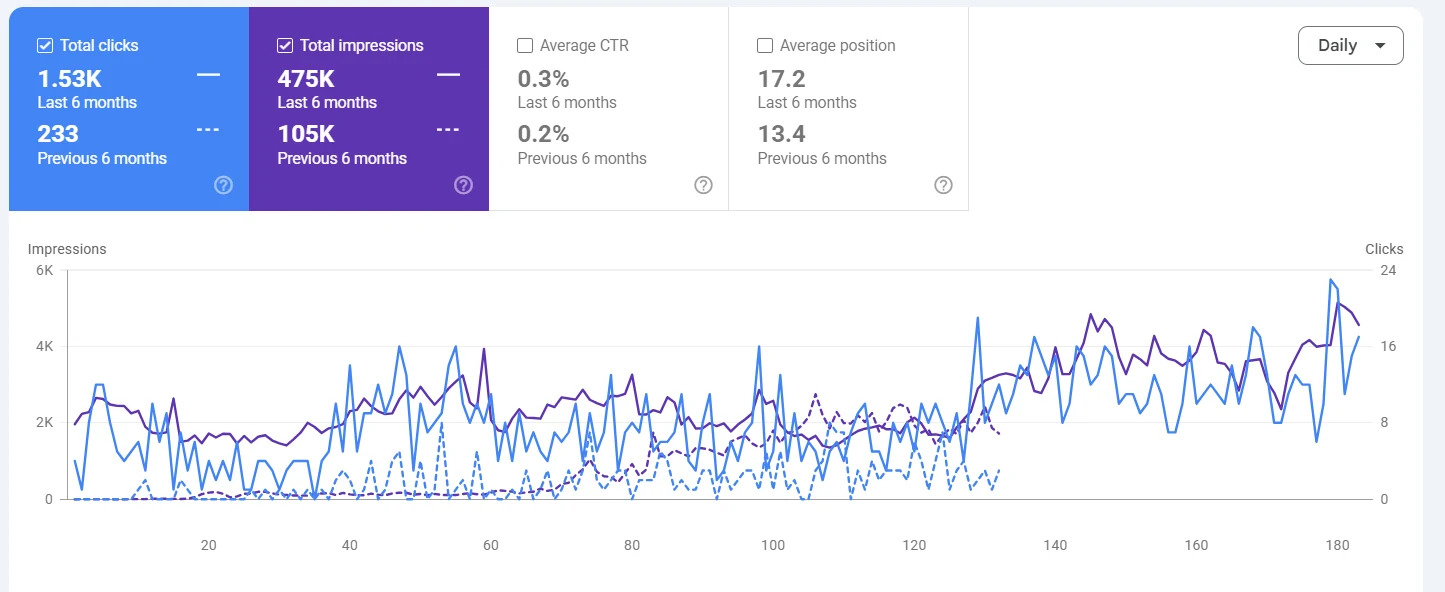
+557%
233 → 1.53K
+352%
105K → 475K
0.3%
up from 0.2%
Google Search Console, last 6 months compared with the previous 6 months. The business isn’t named; the figures are unchanged.
The starting point
Where we started
The website wasn’t new. It had an established set of pages and it already appeared in search. The problem was scale and focus. The visibility it had was limited compared with what a travel business in its market could reasonably earn.
An audit identified opportunities across:
- Important pages that weren’t clearly targeted at a specific search intent
- Existing content that could be improved, expanded or made more relevant
- Topical gaps around travel searches the site had no page for
- Internal linking that didn’t connect related pages strongly enough
- Technical issues getting in the way of crawling and indexing
- Authority signals that had room to grow
- Little connection between informational content and the commercial pages
The challenge
What needed to change
The site had some search visibility, but too little of it, and it missed most of the searches travelers make before they book. Its pages didn’t match the way people search while planning and comparing trips.
Optimizing a handful of keywords wouldn’t fix that. The site needed to compete for a wider and more relevant set of searches, with a stronger technical base, clearer pages, useful supporting content linked to the pages that convert, and more authority behind it. That meant running SEO as one ongoing program, with each part feeding the next.
Goals
What success looked like
The goal was a stronger, longer-lasting presence in organic search:
- More relevant organic visibility, clicks and impressions
- Better visibility across the keyword groups closest to a booking
- Stronger individual landing pages
- Wider topical coverage
- Fewer technical problems holding pages back
This case study reports search metrics. Bookings and revenue aren’t included because we only publish figures we can verify.
The approach
An SEO program built around how travelers search
Four disciplines, run together. Technical work made pages easier to crawl and understand. On-page work made them relevant. Content widened what the site could rank for and pointed readers to commercial pages. Authority helped all of it compete.
Technical SEO
Technical fixes so search engines could crawl, index and understand the key commercial pages.
On-page SEO
Important pages reviewed one by one and matched to what people were actually searching for.
Content
New articles where the site had real gaps, each linked to the pages that could convert.
Off-page SEO
Authority building to support the pages and topics the site was trying to rank for.
What we did
The work, discipline by discipline
What was done, and why.
Technical SEO
Before adding anything, the technical setup had to be sound. If search engines can’t crawl or understand a page properly, better content on it has limited effect.
- A technical audit of the site
- Crawlability and indexability review
- Site architecture and URL structure
- Canonicals, XML sitemap and robots directives
- Internal linking between related pages
- Fixes prioritized by the commercial weight of each page
On-page SEO, page by page
This was the largest part of the work. We didn’t apply one SEO template across the site. Each important page was reviewed against the searches it should answer and optimized on its own.
- Each page matched to its search intent
- Title tags and meta descriptions
- Heading structure
- Keyword and topic targeting
- Content improved, expanded or tightened
- Internal links to and from related pages
- Image alt text where it was missing or unhelpful
- Commercial pages given clearer relevance
- Search intentWhat is the searcher actually trying to plan, compare or book?
- Title, meta & H1Matched to that intent and written for the result page, without keyword stuffing
- Heading structureSections that follow the questions people ask, in order
- ContentGaps filled, thin sections expanded, outdated detail removed
- Internal linksFrom related guides in, and onward to the next useful page
Content and blogs
New SEO-focused articles were published only where they filled a hole. Each one covered a search gap the site couldn’t answer yet, and linked back to the commercial pages it supported.
- Keyword and topic research
- Content gaps mapped against existing pages
- New blog articles built around search intent
- Existing content improved alongside the new articles
- Links from articles to relevant commercial pages
Off-page SEO
Strong pages still need authority behind them. Authority building ran alongside the on-site work, with relevant links chosen over a high link count.
- Relevant link acquisition
- Strengthening authority signals for priority pages and topics
Implementation
How the work unfolded
- Phase 01Audit & strategy
Audit of the site, its search visibility and the searches worth winning.
- Phase 02Technical groundwork
Crawling, indexing, architecture and internal linking fixed first.
- Phase 03Page-level optimization
Important pages reworked one at a time against search intent.
- Phase 04Content expansion
New articles published where the site had real gaps.
- Phase 05Authority & refinement
Off-page work alongside continued tuning of key pages.
- Phase 06Measurement & iteration
Rankings and Search Console data reviewed, then the next priorities set.
Keyword & ranking growth
A much wider set of searches
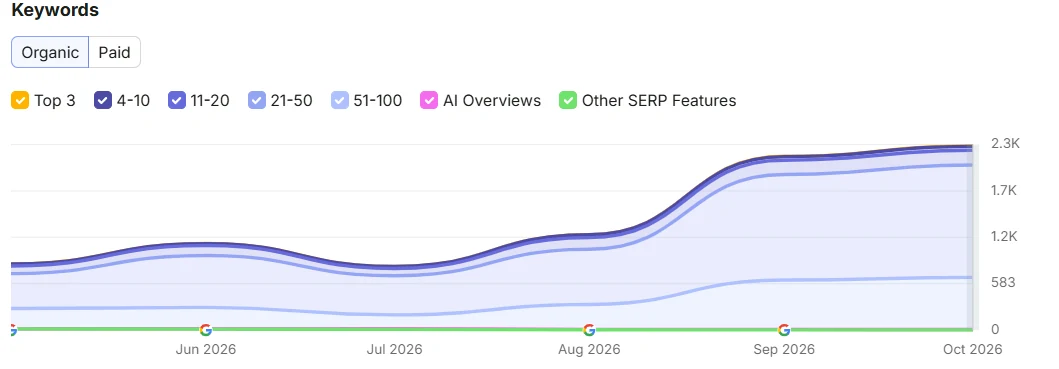
Semrush shows the number of keywords the site ranks for growing through the period, with the biggest step between August and September. Most of the new visibility sits in positions 11 to 100: searches where the site now appears and still has room to climb.
Organic search performance
Travel SEO results, before and after
| Metric | Previous 6 months | Last 6 months |
|---|---|---|
| Organic clicks | 233 | 1.53K |
| Search impressions | 105K | 475K |
| Average CTR | 0.2% | 0.3% |
| Average position | 13.4 | 17.2 |
The site now shows up for far more searches than it did in the previous six months, and that is where the extra clicks came from.
Average position moved from 13.4 to 17.2. That’s common when a site starts appearing for many more searches, often on lower pages at first, so the average drops even as visibility grows. We don’t present it as an improvement.
Organic visibility trend
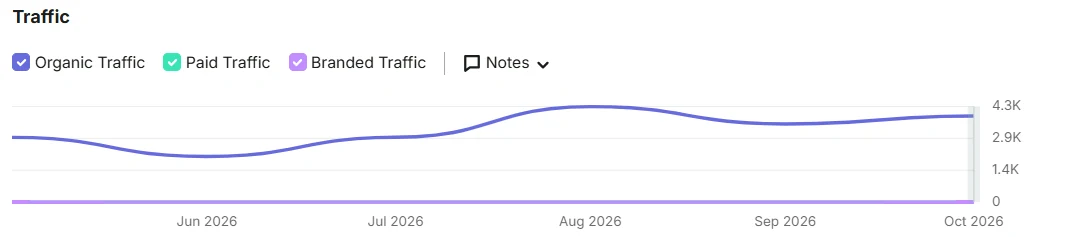
Visibility moving in the same direction
Semrush’s estimated organic traffic rose over the same months, peaking in August. It’s a modeled estimate, so we only read the direction from it. Search Console above is the measured data.
Lessons
What this teaches
- SEO growth rarely comes from one change. Here it came from four disciplines working together.
- Technical fixes gave the page and content work room to perform.
- Existing pages often hold the biggest opportunity. Reworking them individually mattered more than adding pages.
- New content is worth more when it fills a real gap and links to pages that convert.
- Travel website organic traffic growth came from continuous work and measurement over months.
Related services
Services used in this engagement
See also how we do SEO or all case studies.
Want a search strategy like this for your business?
Let’s review your current search visibility, identify the biggest opportunities and show you where SEO can bring in more traffic and inquiries.