
Enterprise SEO
Enterprise SEO for Large Sites Where Small Changes Have Big Consequences
Our enterprise SEO services are built for large websites, where complex architectures, thousands of URLs, multiple teams, markets and technology systems can affect organic search at scale. We find the SEO issues with the biggest impact, prioritize the work and build processes that scale.
Free initial review · No obligation · Reply within 1 business day
Technical depth and clear priorities, with SEO processes built for scale.
Enterprise realities
At scale, SEO problems can spread quietly.
On a large website, an SEO issue rarely stays limited to one page. A template change can affect thousands of URLs. A migration can change how search engines access an entire site. Faceted navigation can create huge numbers of crawlable URL combinations, and weak internal linking can leave important pages buried.
Enterprise SEO therefore depends on systems, monitoring and prioritization. One-off fixes rarely hold.
Problems multiply
A template, CMS or architecture issue can affect thousands of pages at once.
More teams are involved
SEO decisions may involve developers, product teams, content teams, marketing, analytics and external vendors.
International complexity
Multiple countries, languages, domains or subfolders can introduce additional technical and content challenges.
Small mistakes cost more
Migrations, indexation issues and incorrect technical changes can affect large portions of organic visibility.
What’s included
Enterprise SEO services
Enterprise search engine optimization needs a combination of technical SEO, architecture, content strategy, authority and operational processes. We focus on the areas with the greatest potential impact across the site.
Not every enterprise site needs international or programmatic SEO. The strategy depends on the business and the website.
Technical SEO at Scale
Crawlability, indexation, rendering, canonicalization, redirects, structured data, JavaScript SEO and other technical systems across large websites.
Enterprise Site Architecture
Improve URL structures, navigation, taxonomy, internal linking and information architecture so important pages are easier to discover and understand.
International SEO
Support international websites with appropriate country, language, URL and technical structures where multiple markets are involved.
Large-Scale Content Strategy
Identify search demand, content gaps and content systems that can scale without creating large volumes of low-value pages.
SEO Governance & Workflows
Create practical processes so SEO requirements are considered before changes reach production.
SEO Audits & Prioritization
Find the highest-impact issues, estimate what each is worth fixing and turn them into a prioritized roadmap.
Facing a replatform, redesign or international expansion? Bring us in early.
Get My Enterprise SEO StrategyTechnical SEO at scale
Technical SEO becomes a systems problem at scale.
Enterprise websites can contain thousands, hundreds of thousands or more URLs. At that scale, technical SEO is less about fixing individual pages and more about understanding the systems that create, connect, render, crawl and index them.
- Crawlability
- Indexation
- Canonicalization
- Redirects
- XML sitemaps
- Robots directives
- JavaScript rendering
- Internal linking
- Faceted navigation
- Pagination
- Duplicate URL patterns
- Parameter handling
- Structured data
- Core Web Vitals
- Log-file analysis where available
- Large-scale template issues
For very large websites, crawl behavior can become an important consideration, particularly when search engines meet large numbers of low-value, duplicate or parameter-driven URLs, infinite spaces, soft 404s or crawl traps. JavaScript is not a problem in itself; modern sites use it successfully when search engines can access the important content and links. As sites grow, internal linking matters more too: crawl paths, topic and category relationships, contextual links and orphan pages. Not every item applies to every site. Our Technical SEO work goes deeper on each.

Governance
Make SEO part of how your organization builds and ships.
On a large website, SEO cannot depend on one person checking every change manually. It works better when search requirements are considered before a new template, feature, product category, migration or market launch reaches production, while changes are still cheap to make.
- URL and information architecture
- Internal linking rules
- Template requirements
- Indexation controls
- Metadata systems
- Structured data requirements
- Redirect planning
- Migration checklists
- QA processes
- Developer requirements
- Content governance
The goal is to make good SEO decisions repeatable, so the same class of issue stops coming back after every release.
Migrations need the same discipline. Domain, HTTPS, CMS and platform migrations, URL restructuring, site consolidation and large template changes can create serious organic search risk if redirects, canonical signals, internal links, sitemaps, templates and indexation are not planned correctly. Good planning reduces avoidable risk; it cannot promise that nothing changes.

Scale with quality
Grow search coverage without creating thousands of weak pages.
Enterprise websites often have enough products, categories, locations or topics to create large search opportunities. Scale can also create duplication, thin content and pages with little search value. The strategy should identify:
- Which topics deserve dedicated pages
- Which pages can be consolidated
- Which templates need better content
- Where search demand actually exists
- Which pages have commercial value
- Where content overlaps
- Where internal linking should be improved
More pages only help when each one covers something useful. Programmatic SEO can help businesses with legitimate structured data, such as large catalogs, travel inventory, properties or service databases, but it only works when the underlying data, search demand and page value justify the pages being created.

Markets & locations
More markets and locations need their own structure.
Not every enterprise operates internationally, but for those that do, the considerations go well beyond adding hreflang:
- Country targeting
- Language targeting
- URL structure
- hreflang where appropriate
- Canonicalization
- International site architecture
- Localized content
- Duplicate content risks
- Market-specific search behavior
Market pages should reflect places the business actually serves. For enterprises with many physical locations, the work covers location architecture, location pages, Google Business Profiles, reviews, business information and location-specific relevance, without fake locations or identical pages with only the city name changed. Our Local SEO service covers this in more detail.

Prioritization
An enterprise SEO audit should not leave your team with 400 tasks.
Large websites can produce hundreds of SEO recommendations. What your team needs is a clear place to start. For each important issue, we identify:
- What the issue is
- Why it is worth fixing
- How large the impact could be
- What depends on what
- Who needs to implement it
- What should happen first
Enterprise search strategy also has to account for AI-powered search, where consistent templates and clearly described products and services make a large site easier to interpret. How we approach AI SEO.

What changes
What enterprise SEO delivers
The fundamentals are the same as any SEO. The challenge is scale, complexity and coordination: more URLs, templates, teams, markets and dependencies.
Fewer recurring SEO problems
Build processes that reduce the chance of the same technical or content issues appearing repeatedly.
Better search architecture
Make important pages easier for users and search engines to discover and understand.
More useful search coverage
Expand organic visibility around your priority topics and commercial areas.
Clearer SEO priorities
Point teams at the changes with the largest potential impact instead of treating every recommendation equally.
How it works
How enterprise SEO engagements work
Working with an enterprise SEO company can mean strategy, audits, consulting, implementation support, collaboration with your teams or ongoing SEO support.
Understand the System
Review the business model, website architecture, technology stack, teams, markets and search priorities.
Audit at Scale
Analyze technical SEO, crawlability, indexation, templates, internal linking, content, architecture and other major search systems.
Prioritize
Separate high-impact issues from low-value recommendations and build a roadmap around business impact and implementation effort.
Implement & Govern
Work with developers, content teams, product teams and stakeholders to make changes and build repeatable SEO processes.
Measure & Iterate
Track organic visibility, qualified traffic, important landing pages, search demand and business outcomes, then refine the strategy.
Why GrowthFueling
What we do differently
Proof
Results we can show you
An anonymized case study, with the source data behind it. Alongside it, the measures we report on for this work.
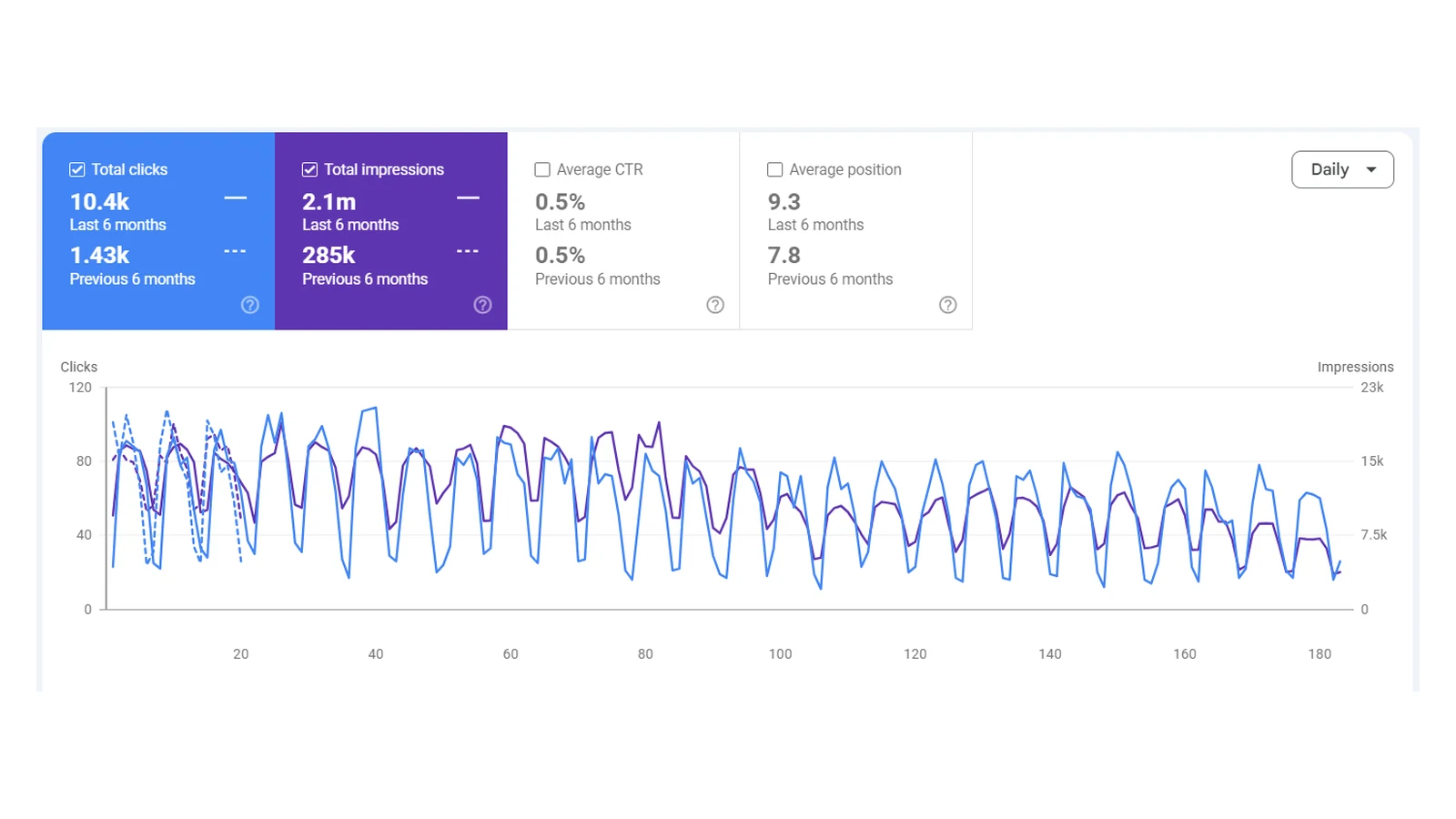
Organic visibility for a B2B consulting firm in the construction sector
B2B consulting firm in the construction sector
What we report on
- Organic visibility, including non-brand and important keyword groups
- Qualified organic traffic and landing-page performance
- Indexation health and crawl behavior
- Conversions, and revenue where measurable
- Market or category visibility
Related
Often paired with Enterprise SEO
Keep exploring: our SEO services, how we approach E-commerce SEO and AI SEO and GEO, or the latest search insights.
What is Enterprise SEO?
Enterprise SEO is the process of improving organic search visibility for large or complex websites where technical architecture, content systems, multiple teams, markets or large numbers of URLs create additional SEO challenges.
What makes Enterprise SEO different from regular SEO?
The fundamentals are similar, but the scale and complexity are different. Enterprise SEO often involves large website architectures, templates, multiple teams, technical systems, migrations, international markets and processes that can affect thousands of pages at once.
How many pages does a website need to be considered enterprise?
There is no fixed page count. Enterprise SEO is more about the complexity of the website, organization, technology, markets and SEO operations than a specific number of URLs.
Can you work with an internal SEO team?
Yes. We can act as an enterprise SEO consultant alongside an internal SEO team, developers, content teams or marketing department. The engagement can focus on strategy, technical SEO, audits, consulting, implementation support or specific enterprise SEO projects.
Do you handle enterprise website migrations?
Yes. We can help plan and review SEO requirements for platform, CMS, domain, URL and website migrations, including redirects, canonicalization, internal links, sitemaps and post-launch monitoring.
Do you work with international websites?
Yes. Where businesses operate across multiple countries or languages, Enterprise SEO can include international site architecture, localized content, hreflang implementation and market-specific search considerations.
Can you guarantee enterprise SEO results?
No. Search performance depends on competition, search demand, the website, implementation and Google’s systems. We focus on identifying and implementing changes that can improve organic search visibility and business outcomes.
Can Enterprise SEO include technical SEO?
Yes. Technical SEO is often a major part of enterprise SEO because large websites can have complex crawling, rendering, indexation, URL and architecture issues.
Do you do programmatic SEO?
Yes, where the data supports it. Programmatic SEO at scale makes sense for large catalogs, locations, listings or other structured datasets where each page answers a real search with unique information. Before any templates are built we check search demand, data quality and how the pages will be linked and indexed, so the site doesn’t end up with thousands of thin pages.
Do you use log file analysis?
Where server logs are available, yes. Log file analysis shows which URLs search engine bots actually request, how often, and where crawl activity is being spent on parameters, redirects or low-value pages. On large sites it is often the quickest way to confirm whether important sections are being crawled.
Start here
Talk to us about enterprise search
Tell us about your website, markets, technology stack and current SEO challenges. We can help identify where enterprise SEO can have the greatest impact.
Scale search without breaking what already works.
Large websites need SEO systems that can scale with the business. Let’s identify the technical, structural and strategic changes that can improve search visibility without creating more problems downstream.