
Google Ads management
Google Ads That Bring In Qualified Leads.
Our Google Ads management services put your business in front of people already searching for what you sell. We build campaigns around search intent, account structure, conversion tracking, landing pages and what each conversion is actually worth to you.
Free initial review · No obligation · Reply within 1 business day
- Search, Performance Max & Shopping
- Conversion tracking that can be trusted
- Built around qualified outcomes
The problem
Most Google Ads accounts are optimized for the wrong thing.
A campaign can generate clicks, impressions and conversions without bringing in the customers a business actually wants. When that happens, the cause is usually the strategy or the measurement.
Cheap clicks
A low CPC does not mean the traffic is valuable.
Too many broad searches
Loose targeting can spend budget on searches that are related to the business but not commercially useful.
Weak conversion signals
If Google is optimizing toward the wrong action, automated bidding can move in the wrong direction.
No connection to the landing page
The ad, search intent and landing page need to answer the same question.
Our approach
Search intent first, then structure, tracking and testing.
Google Ads works best when campaign structure follows what people are actually searching for. Google’s campaign-type recommendations come later. First we look at the searches and the business objective, then decide how to structure the account.
Before building anything, we look at
- Search intent
- Commercial value
- Keyword themes
- Search terms
- Competition
- Landing pages
- Conversion actions
- Business economics
Services
Google Ads management services
Writing ads and changing bids is a small part of Google Ads management, and of any PPC management services worth paying for. The account structure, targeting, search terms, landing pages and conversion data all affect performance.
Google Search Ads
Campaigns built around high-intent searches, commercial keywords and clear landing-page intent.
Performance Max Management
PMax campaigns structured and measured around your priority products, services and conversion goals.
Keyword Research & Search Intent
Identify the searches worth targeting and separate commercial intent from irrelevant or low-value demand.
Campaign Structure
Campaigns and ad groups organized around clear themes, search intent and business priorities.
Negative Keywords
Cut wasted spend on searches that sound related to the business but rarely turn into customers.
Conversion Tracking Setup
Track forms, calls, purchases and other valuable actions so Google has useful signals to optimize toward.
Landing Page Match
Check that the ad, the search and the landing page all say the same thing. A strong ad can’t rescue a page that answers a different question.
Ongoing Optimization
Review search terms, bids, budgets, conversion data and campaign performance to decide what should change next.
Already running campaigns? Share access and we can look at the account and tracking before our first call.
Get a Google Ads StrategySearch Ads
Capture demand when people are already searching.
With search campaigns, the person has already told you what they want by typing it. Our job is to check that:
- The keyword matches the intent
- The ad matches the search
- The landing page matches the promise
- The conversion action is clear
- The traffic is commercially relevant
Exact and phrase match, search-term reviews, negative keywords, ad relevance, landing pages and conversion tracking all serve that goal. Google now reads match types by meaning as well as wording, so no single match type suits every account.

Performance Max
Use Performance Max when it has a clear role.
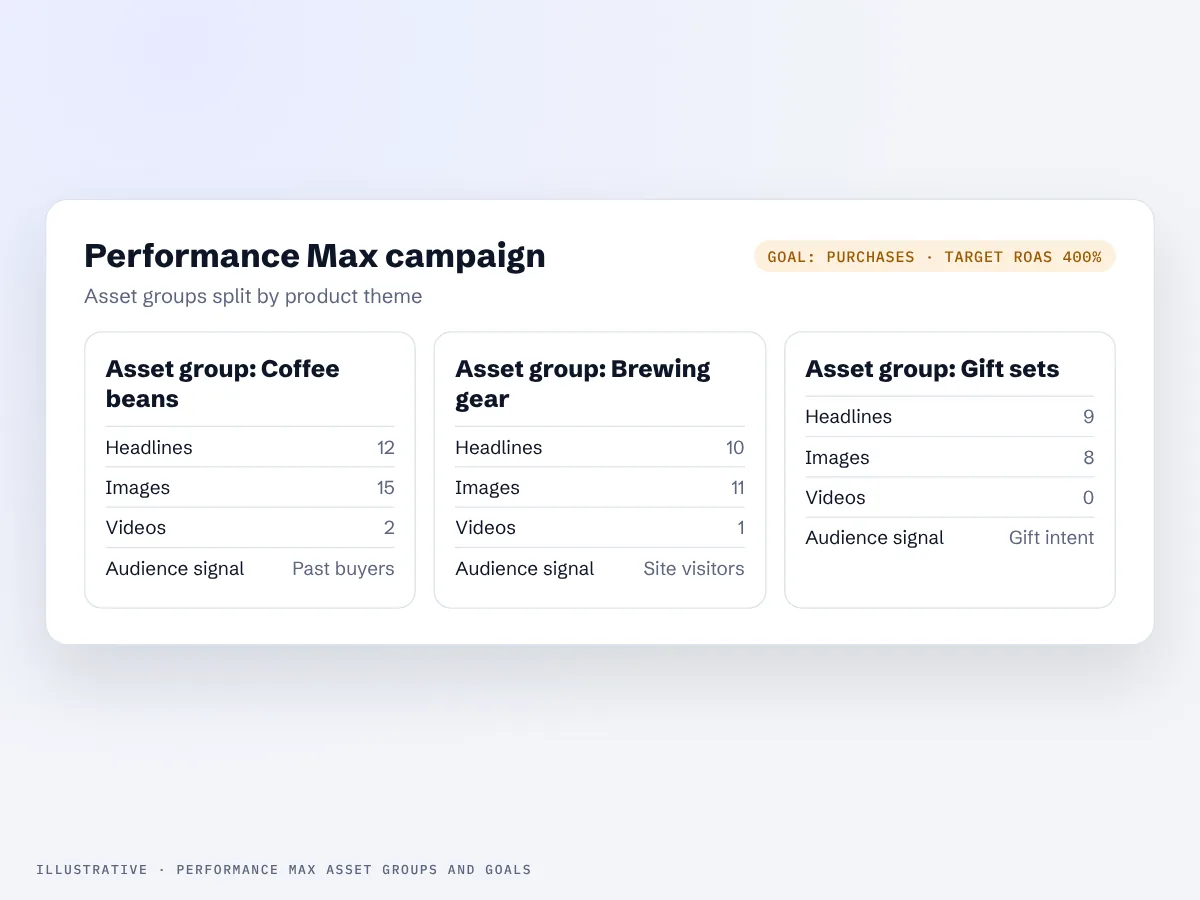
Performance Max serves ads across Google’s inventory (Search, Shopping, YouTube, Display, Discover, Gmail and Maps) from one campaign and uses Google’s automation to optimize toward the conversion goals you choose. It is not automatically better than Search. It tends to be useful when:
- Conversion tracking can be trusted
- The account has enough conversion data
- The campaign has a clear objective
- Asset and product inputs are strong
- Budget and economics support automation
It also needs good creative assets, audience signals, a product feed for e-commerce, whatever exclusions Google allows, and reporting that shows where the money goes.
Conversion tracking
If the conversion data is wrong, the campaign is learning the wrong lesson.
Google Ads automation is only as useful as the conversion signals it receives. We set up measurement around the actions the business actually wants more of:
- Google Ads conversion actions
- GA4
- Google Tag Manager
- Form submissions
- Phone calls
- Purchases
- Revenue
- E-commerce events
- Lead quality where available
No setup is perfect. Google Ads, GA4 and your own systems can report different numbers for legitimate reasons, so the data needs interpreting before anyone acts on it.

Landing pages
The click is only the start.
Even a good campaign struggles when the landing page doesn’t match the search or the offer. So we review the landing page as part of the job, looking at:
- Search intent
- Message match
- Headline
- Offer
- Page structure
- Trust signals
- Calls to action
- Mobile experience
- Conversion friction

In the details
Where accounts are won or lost
The search terms tell you what the market is actually asking for.
Keyword research tells you what you expect people to search. Search-term data shows what they actually searched before clicking an ad. It can help identify:
- Valuable queries
- Irrelevant searches
- New keyword opportunities
- Negative keywords
- Commercial language
- Content and landing-page opportunities
The same data is useful for SEO planning.
Not every relevant search is a valuable search.
A search can be related to your business without being worth paying for. Negative keyword work helps separate out:
- Research intent
- Jobs and careers
- Education
- Free-seeking searches
- Support queries
- Irrelevant products, services or use cases
The exact exclusions depend on the business.
The ad should match the reason behind the search.
Stuffing keywords into the headline doesn’t make good ad copy. Good copy makes the link between search, offer and landing page clear, through:
- Relevance to the query
- Commercial intent
- A clear offer
- Differentiation
- Clear calls to action
- Ongoing testing
And no “best in the industry” claims we can’t back up.
Bidding comes after the business logic.
Automated bidding can help, but switching bid strategy won’t fix problems with targeting, conversion tracking or campaign structure. Budget decisions consider:
- CPC, conversion rate and CPA
- Conversion volume and search demand
- Customer value and revenue
- Gross margin where available
- ROAS and profitability
There is no single “good CPC” or “good ROAS” that applies to every industry.
Google Ads for e-commerce.
For product businesses, paid search connects product data, search demand and purchase intent. The work usually covers:
- Merchant Center and product feeds
- Google Shopping and Performance Max
- Product titles and attributes
- Product-level performance
- Conversion tracking and e-commerce remarketing
- Product page match
Our broader E-commerce Ads service covers this in full.
Sometimes the right move is to remove something.
In pay per click management, more campaigns and more keywords rarely fix a struggling account. A drop in conversions doesn’t automatically call for a bigger budget, and no budget fixes bad conversion tracking.
Cheap clicks can still be useless clicks. Cutting what isn’t working often does more than adding something new.
Optimization & reporting
How we manage your Google Ads, week by week
The cadence depends on the account. Changes are made when the data supports them, and every change is explained.
Understand the business
Goals, products or services, customers, margins, geography and conversion goals.
Audit the account
Campaign structure, search terms, conversion tracking, bidding, budgets, ads and landing pages.
Map search intent
Identify valuable commercial searches and separate them from low-value or irrelevant demand.
Fix the basics
Tracking, structure, targeting, negative keywords, landing pages and conversion actions.
Launch or rebuild
Build campaigns around the business and its search intent, from scratch where needed.
Review the data
Search terms, conversions, costs, landing pages and business outcomes.
Optimize
Adjust targeting, budgets, bids, ads and structure based on what the data supports.
Scale carefully
Increase investment where the economics support it. Having budget available isn’t a reason on its own.
Why GrowthFueling
Google Ads management without the black box.
Hire us as a Google Ads agency to run the account or as a Google Ads consultant to review it. Either way, you see what changed and why.
Google Ads + SEO
Google Ads and SEO work better when they share what they learn.
Paid search reaches commercial demand quickly, and SEO builds organic visibility over time. When one team plans both around the same search intent, data moves between them. Running ads won’t lift your organic rankings, but the search-term data is still worth having. See our SEO services.
Paid search can reveal
- Converting search terms
- Commercial language
- High-value categories
- Landing pages that work
- Emerging demand
SEO can inform
- Keyword themes
- Search intent
- Content opportunities
- Competitor gaps
- Landing-page strategy
Results
What good Google Ads management should improve
An anonymized Google Ads case study, with the source data behind it. Alongside it, the measures we track on every account.

Google Ads franchise lead generation case study: 1.09K lead conversions for a wellness brand
Health & wellness franchise brand
What we look at
- Search-term quality
- Qualified conversions
- Conversion rate
- CPA
- Revenue and ROAS
- Landing-page performance
- Wasted spend
- Budget allocation
Industries
Google Ads for industries we know
Google Ads for lead generation, for B2B and for e-commerce each need a different setup. Campaign strategy changes with the business model and the buying journey.



Selling products? See E-commerce Ads. Also part of our Paid Advertising services: Meta Ads. Related: Technical SEO, E-commerce SEO, how we do SEO and the latest insights.
What does a Google Ads management service include?
Google Ads management usually covers an account audit, campaign structure, keyword and search-term analysis, negative keywords, ad copy, bidding, budget allocation, conversion tracking, landing-page fixes and ongoing optimization.
How much does Google Ads management cost?
The fee depends on account size, how complex the campaigns are, how many markets you target and how hands-on you need us to be. Ad spend is paid to Google separately.
How much should I spend on Google Ads?
There’s no standard starting budget. It depends on search demand, CPCs, conversion rates and what a customer is worth to you. We look for a budget big enough to produce data you can act on and small enough that the numbers still work.
How quickly can Google Ads generate results?
Ads start showing once Google approves them and they’re eligible to serve. After that, results depend on targeting, search demand, competition, landing pages, conversion tracking and budget.
Do you guarantee leads or sales?
No. We don’t promise a set number of leads, sales or a ROAS figure. We commit to the work itself: account structure, targeting, tracking, landing pages and steady optimization.
Do you manage Performance Max?
Yes, when the account has a clear objective, solid conversion signals, decent assets and the margins to support automated bidding.
Do you manage Google Shopping?
Yes. For online stores, Google Shopping and Performance Max sit within our E-commerce Ads service.
Can you manage Google Ads and SEO together?
Yes. SEO is our core service and Google Ads is a secondary acquisition channel. Running both lets paid search data feed into the wider search plan.
Do you work with existing Google Ads accounts?
Yes. We can audit and improve an existing account or rebuild it when the current setup is beyond patching.
What does a Google Ads audit cover?
A Google Ads audit looks at account structure, search terms, negative keywords, conversion tracking, bidding, budgets, ads and landing pages. You get a prioritized list of what to fix first and why, and it is usually where we start with an existing account.
Can you set up Google Ads conversion tracking?
Yes. Conversion tracking setup is part of the work: Google Ads conversion actions, GA4 and Google Tag Manager, form submissions, calls and purchases. We check that each conversion counts something the business actually wants, so automated bidding learns from the right signal.
How do you reduce cost per lead in Google Ads?
Usually by cutting wasted spend first: search-term reviews, negative keywords, a tighter campaign structure and landing pages that match the search. We also check whether the conversion action counts real inquiries, because a lower cost per lead means little if those leads never become customers. We can’t promise a specific reduction.
Do you run Google Ads for B2B companies?
Yes. Google Ads for B2B often means lower search volume, higher CPCs and longer sales cycles, so we focus on high-intent queries and exclude job, research and free-seeking searches. Where CRM data is available, we look at lead quality and pipeline as well as cost per lead.
Google Ads
Get a Google Ads strategy built around qualified demand
Tell us about your business, your market and what you want Google Ads to achieve. We’ll look at the current opportunity, the search demand and what should happen first.
Spend on searches that can pay back.
We start by working out which searches are worth paying for and what happens after the click, then check that the numbers add up.