The short version
- AI tools name manufacturers whose websites state products, specs and certifications as plain text.
- Give each product family and application its own page, with spec tables and standards written out.
- Answer the selection, comparison and buying questions your sales team hears every week.
- Keep company facts identical across your site, directories and distributors, and check AI answers monthly.
Manufacturers get found in ChatGPT and AI search when their website states products, specifications, capabilities, certifications and industries served in plain HTML text, with a page for each product family and application. Add clear company facts, consistent directory listings and answers to real buyer questions, and make sure AI crawlers can reach the site.
Engineers and buyers now ask ChatGPT, Perplexity, Gemini and Google AI Overviews to explain a material, compare two processes or list suppliers for a part. The manufacturers named in those answers are rarely the biggest. They are the ones whose websites are easiest to read and trust. This guide covers why many manufacturers are missing, the six fixes that matter most and how to check your own visibility. For the basics of the topic, see what AEO is.
How industrial buyers use AI tools
Industrial buying still involves drawings, samples and calls with sales engineers. AI tools now often come in earlier, during research and shortlisting. Typical questions look like this:
- Learning: "What is the difference between investment casting and sand casting?"
- Specifying: "Which stainless steel grade is best for a marine pump shaft?"
- Shortlisting: "Manufacturers of PTFE-lined valves that export to Europe"
- Comparing: "CNC machining vs die casting for 5,000 aluminum parts a year"
- Checking: "Is [company] ISO 9001 certified?" or "Where is [company]'s plant?"
Each of these questions is a chance to be named. The first two build trust before a buyer knows your name. The last three decide whether you make the shortlist.
Why many manufacturers are missing from AI answers
Most manufacturing websites were built as online brochures. They look fine to a visitor who already knows the company, but they give AI tools very little to work with. The common problems are:
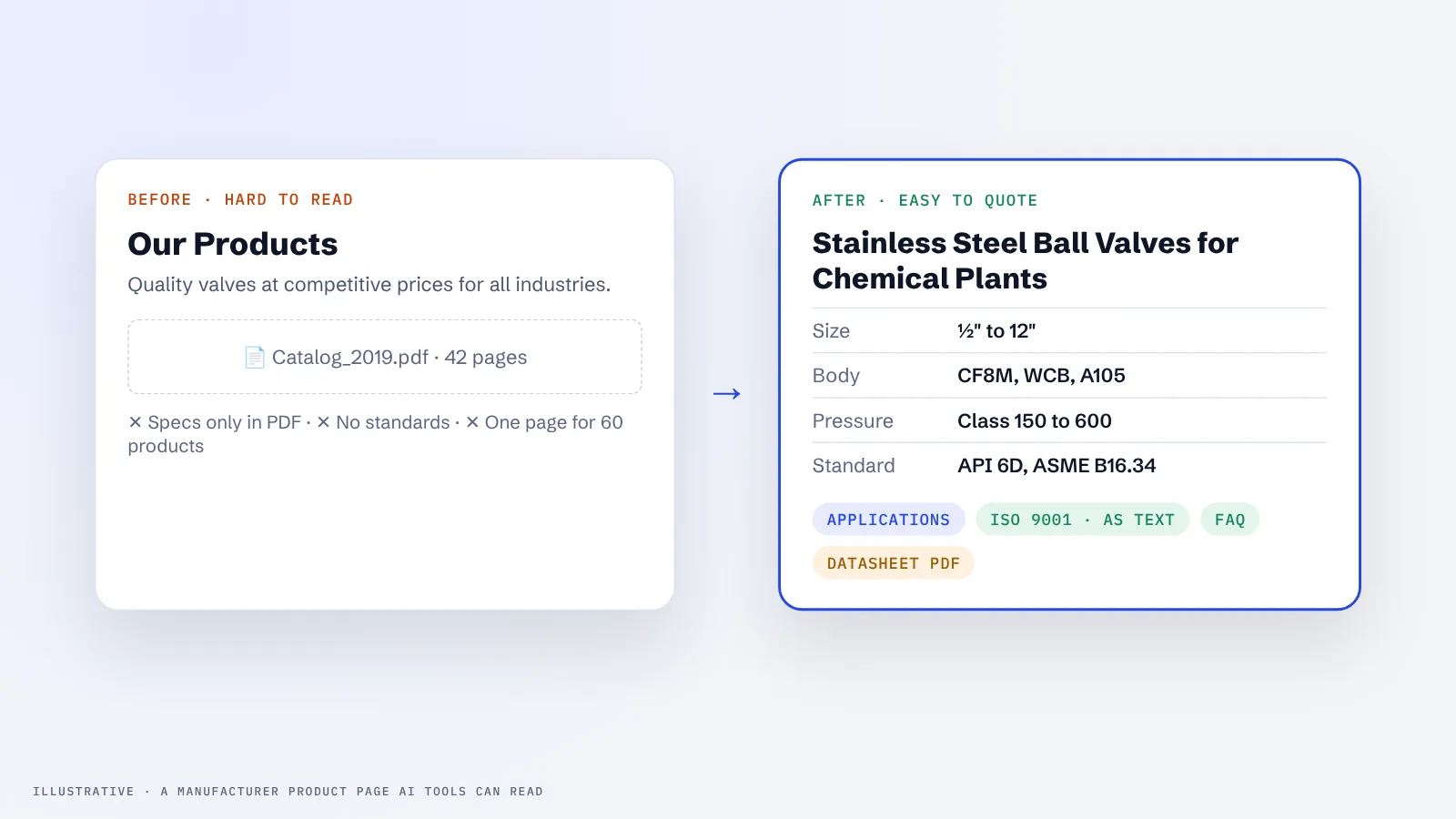
- Specs locked in PDFs or images. The catalog is a 40-page PDF or a set of product photos with the dimensions printed on them, so the details are hard to read and quote.
- One page for everything. A single "Products" page lists 60 items with no page of their own.
- General claims instead of facts. "High-quality products at competitive prices" says nothing an AI tool can use.
- Certifications and capacity not stated. ISO certificates sit in an image gallery, and the materials, size ranges and tolerances you work to are not written anywhere.
- Directories and distributors outrank you. Marketplace listings describe your products better than your own site does, so AI tools quote them instead.
- Different facts in different places. The company name, address or product range varies between the website, LinkedIn and directory listings.
The good news is that all of these can be fixed with work you control.
Step 1: Put products and specifications in readable text
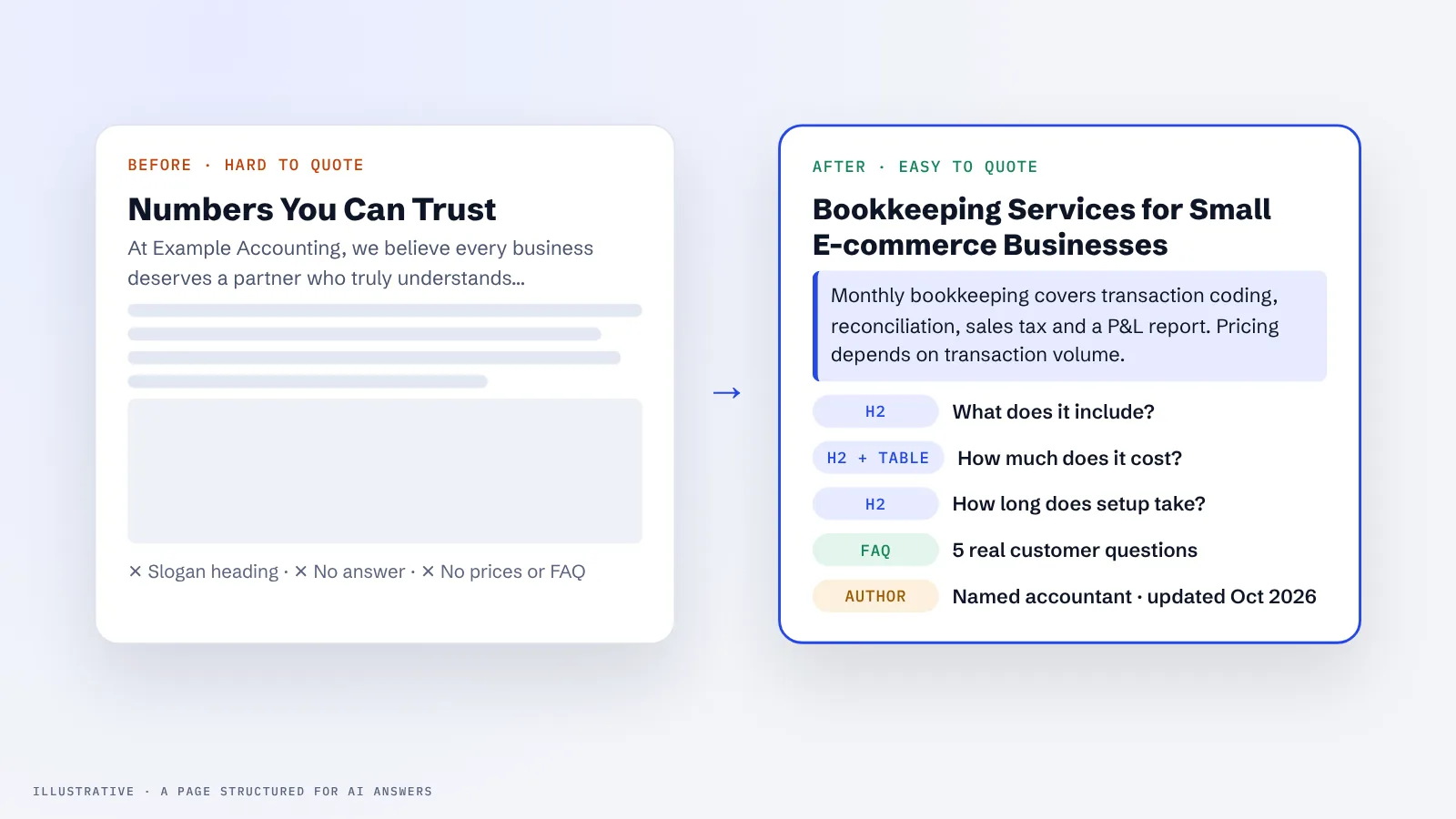
Give each product family its own page, and write the important details as text and HTML tables, not only in a PDF or image. A product page should cover:
- What the product is and what it is used for, in the first two or three sentences
- Sizes, grades, materials, pressure or load ratings, tolerances and finishes
- Standards it meets, such as ASTM, DIN, API or IS codes, written out in full
- Options and custom variations you offer
- Minimum order quantity, typical lead times and whether you export, if you are happy to share them
- A link to the PDF datasheet as an extra, not a replacement
A spec table on the page is one of the most useful things you can add. It is easy for buyers to scan, and easy for AI tools and search engines to read. You can also add Product structured data; Google supports it for product pages even when people can't buy directly on the site. Our guide on how to structure website content for AI answers shows the page layout in more detail.
Step 2: Create pages for applications and industries
Buyers often search by the problem, not the product. A pump buyer in a chemical plant asks about corrosive fluids, not about your model numbers. Pages built around applications and industries match those questions:
- Application pages: "Valves for high-temperature steam lines", "Fasteners for offshore structures"
- Industry pages: oil and gas, food processing, water treatment, automotive, with the products and standards each one needs
- Process or capability pages: CNC machining, forging, powder coating, testing, each with machine sizes and limits
Each page should explain the buyer's problem, which of your products or processes fit, and why. Real examples, such as a project you completed for a type of customer, make the page far more useful than a list of features. This is also the core of our SEO for manufacturers work.
Step 3: Answer the questions engineers and buyers ask
Write down the questions your sales team hears every week and answer them on the site. Good topics for manufacturers include:
- Selection guides: how to choose a grade, size or process for a given use
- Comparisons: one material or process against another, with honest trade-offs
- Buying questions: MOQ, lead times, samples, custom drawings, export documents
- Quality questions: inspection steps, test reports, traceability, certifications
- Troubleshooting: common failures and how to prevent them
Put a short, direct answer at the top of each section and add an FAQ to key product and application pages. Our free FAQ schema generator creates the matching structured data. A selection guide written by your own engineers, with real numbers, is exactly the kind of page AI tools like to quote, because it is specific and hard to find elsewhere.
Step 4: State your business facts clearly
When a buyer asks an AI tool about a supplier, it looks for facts it can confirm. Make these easy to find on your About, contact and quality pages:
| Fact | Where to state it |
|---|---|
| What you make and for which industries | Homepage, first sentence or two |
| Plant and office locations | Contact and About pages |
| Certifications, with certificate numbers or issuing bodies | Quality page, as text, not only images |
| Year founded and size of the team or plant | About page |
| Countries you supply or export to | About page and relevant product pages |
| Main machines, capacity or size limits | Capability or process pages |
Add Organization structured data with your logo, address and links to official profiles. Only publish what you are comfortable sharing, and keep it up to date. A wrong capacity figure repeated by an AI tool is worse than none.
Step 5: Be present where AI tools look for suppliers
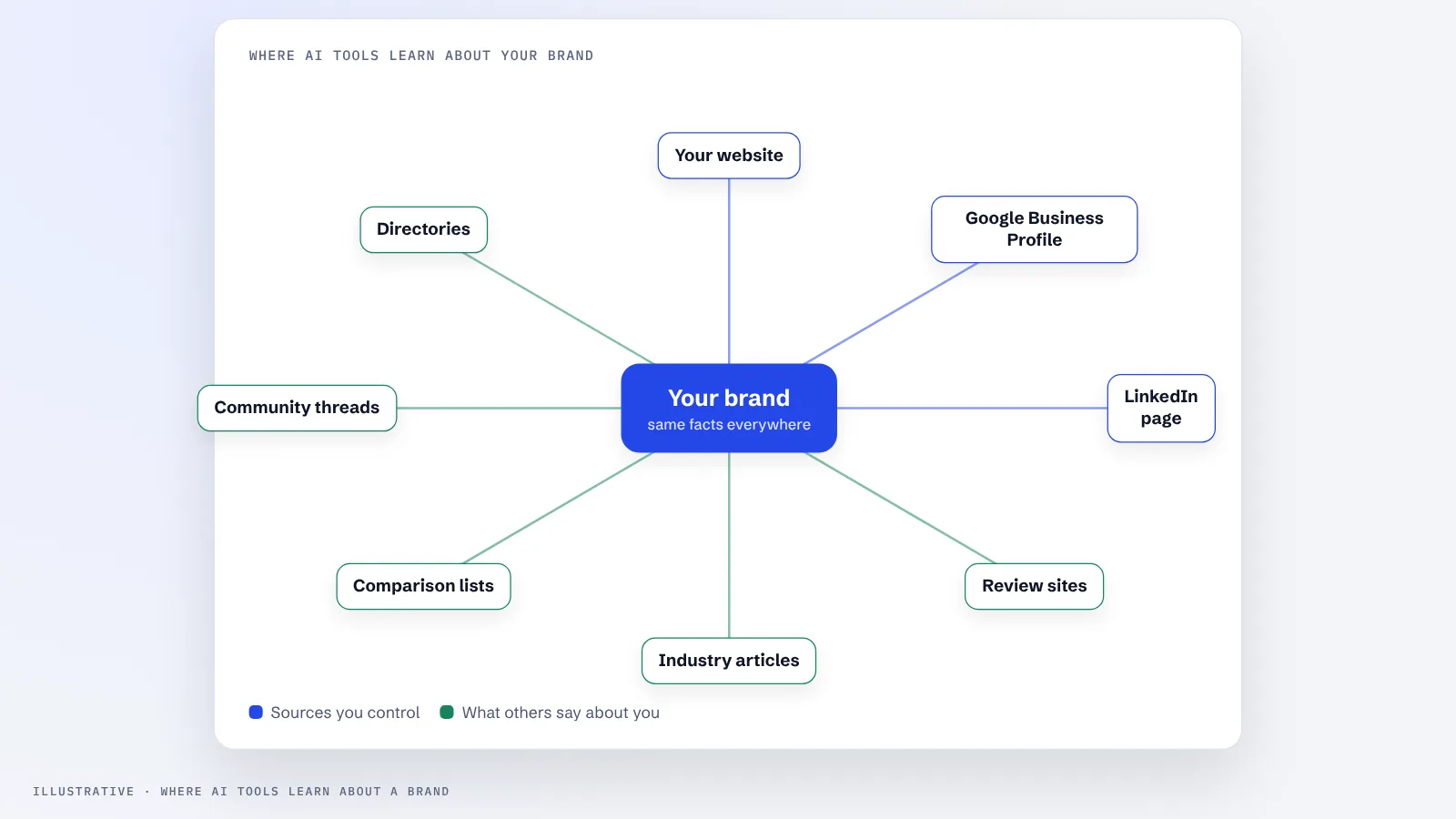
For supplier questions, AI tools often cite industrial directories, marketplaces, trade associations and industry publications alongside company websites. Depending on your markets, that might include Thomasnet in North America, Europages or Kompass in Europe, and IndiaMART or TradeIndia in India, plus the associations and trade magazines in your sector.
- Make your listings complete and identical to your website: name, address, product range, certifications and website link
- Ask distributors and dealers to describe your products accurately and link to the right product pages
- Join the trade associations that publish member lists, and keep your profile current
- Offer technical articles or expert comments to the publications your buyers read
- Keep a LinkedIn company page with the same description and regular posts about real projects
Before you spend time on all of them, check which sources the AI tools actually cite for your products. Our guide on how to improve brand visibility in AI search explains how to find and work on those sources.
Step 6: Make sure AI tools can reach the site
Many manufacturing sites have technical problems that stop AI tools before content matters. Check that:
- robots.txt allows search bots and AI search bots such as OAI-SearchBot and PerplexityBot
- Product pages are indexed in both Google and Bing, and not hidden behind forms or logins
- Product details are in the page HTML, not loaded only after a filter or search on the page
- Old catalog URLs redirect to the new pages after a website rebuild
- The site loads quickly on mobile, where many first searches happen
Our technical SEO service covers these checks for large catalogs.
How to check whether AI tools name you
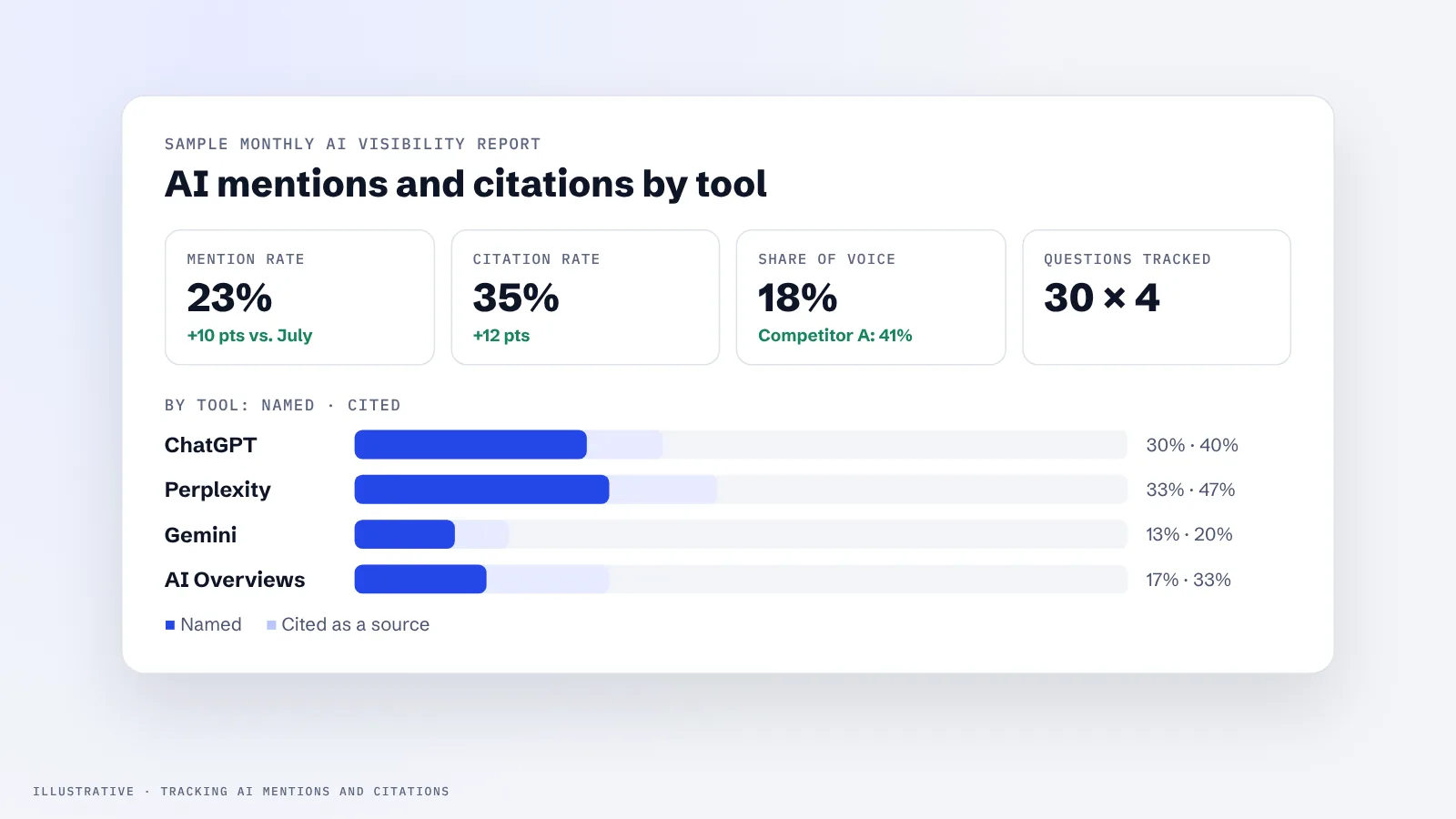
Make a list of 15 to 30 questions in three groups: questions about your products and processes, shortlist questions ("manufacturers of X in Y" or "suppliers of X for Z industry") and questions that name your business. Ask each one in ChatGPT, Perplexity, Gemini and Google, and record whether you are named, whether your site is cited, which competitors appear and which sources are used.
Repeat the same check every month. Our guide on how to measure AI search visibility includes a simple tracking sheet. If you would rather have it done for you, our free AI visibility check runs your buyers' questions through the main AI tools.
What to expect
Fixing access problems and adding clear product pages usually shows up first, once the pages are crawled and indexed. Being named in shortlist answers takes longer, because it also depends on directories, publications and other sites describing you. Plan for several months of steady work. No one can promise that a tool will name your business for a given question, so judge progress by how often you appear across your question list over time.
This work also helps ordinary Google rankings. Clear product pages, application pages and spec tables are what buyers want in normal search results too, which is why we treat AI search as part of B2B SEO rather than a separate project.
FAQ
Do industrial buyers really use ChatGPT to find suppliers?
Many use AI tools during research: to learn about materials and processes, compare options and build a first list of suppliers. The final decision still involves quotes, samples and calls, but being named early decides who gets contacted.
Should manufacturers remove PDF catalogs?
No. Keep PDFs for buyers who want to download them, but put the key specifications on the product pages as text and tables too. PDFs are harder to read, link to and keep up to date.
What if we can't publish prices?
That is normal in manufacturing. You can still publish what affects price, typical order sizes, lead time ranges and what a buyer needs to send for a quote. Those facts answer real questions without giving away pricing.
Do directory listings help with AI search?
Yes, when they are complete and consistent with your website. AI tools often cite industrial directories and marketplaces for supplier questions, so a strong listing can get you named even before your own site ranks.
How long does it take for a manufacturer to show up in AI answers?
Technical fixes and new product pages can be picked up within weeks of being indexed. Appearing in shortlist answers usually takes several months, because it depends on other sites describing you as well.
Want to see how AI tools describe your business today? Our free AI visibility check runs your buyers' questions through ChatGPT, Perplexity, Gemini and Google AI Overviews and shows when you are named, cited or missing.