The short version
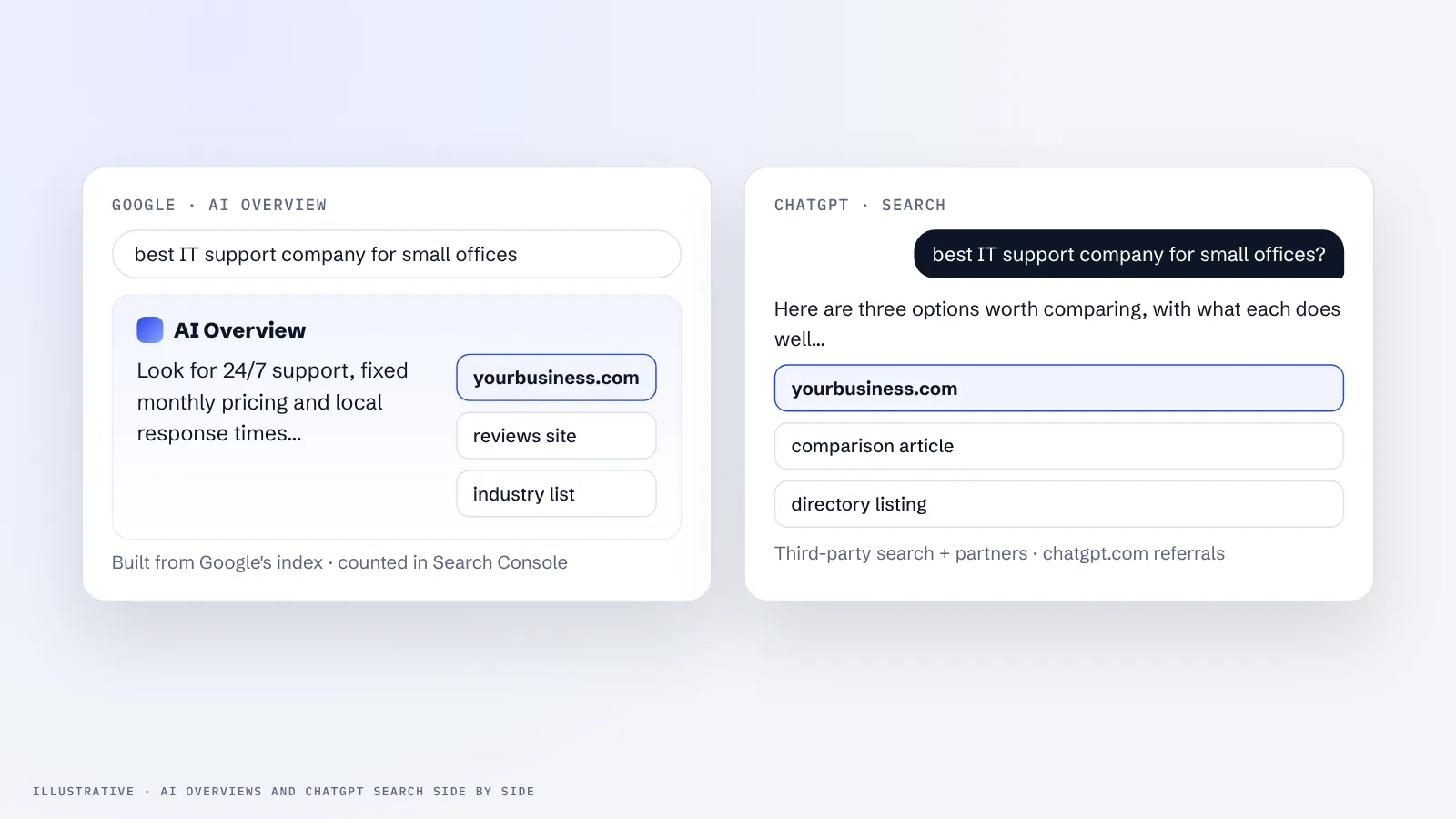
- AI Overviews draw on Google's index; ChatGPT search uses third-party search providers and partner content.
- A business can be visible in one and missing in the other, so check both.
- For most small and B2B businesses, Google AI Overviews matters more today.
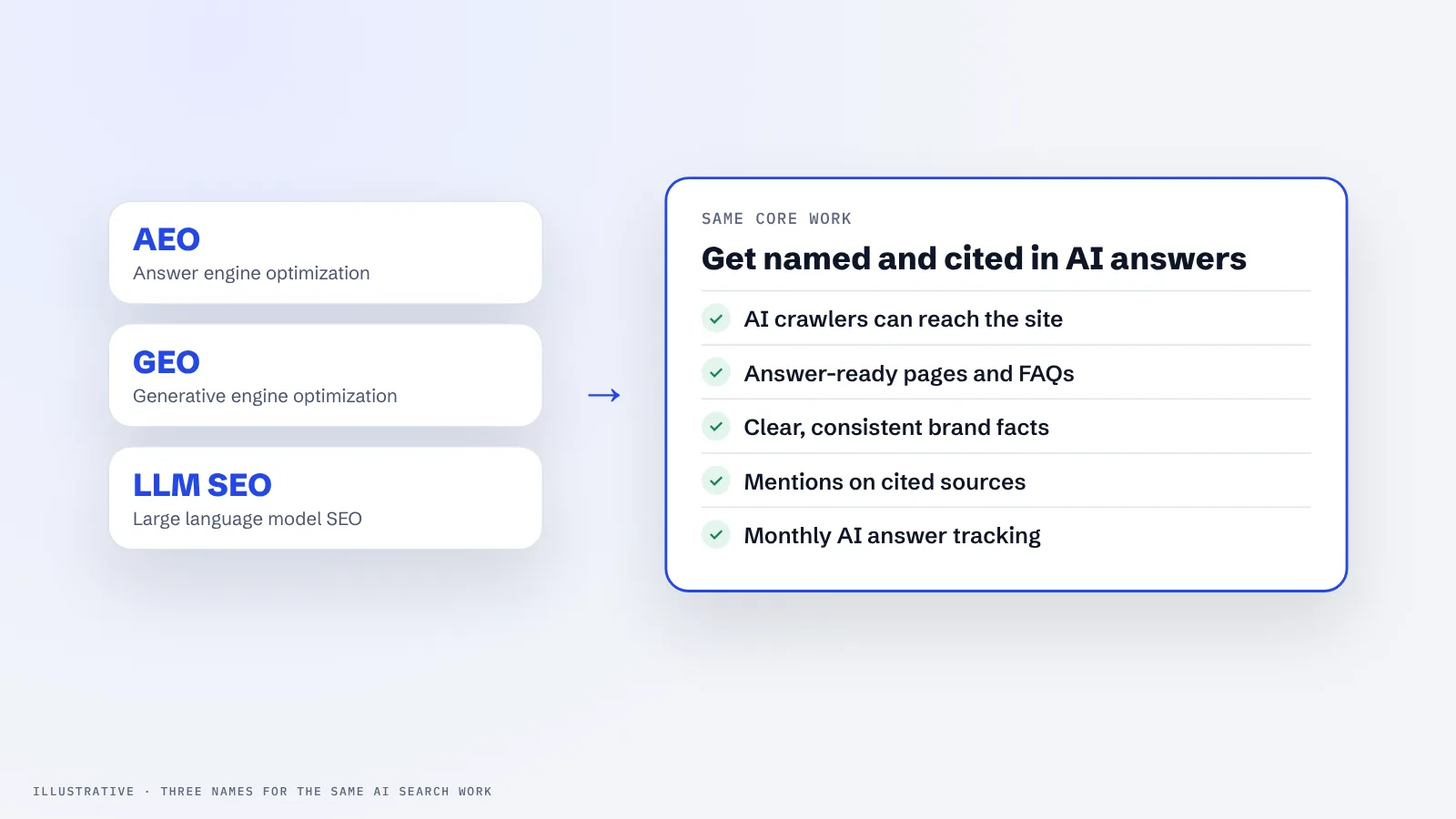
- The same work helps both: SEO basics, answer-first pages with FAQs, consistent brand facts and open crawler access.
Google AI Overviews and ChatGPT search both answer questions with AI-written summaries and links, but they work differently. AI Overviews sit on top of Google results and draw on Google's index. ChatGPT search runs inside a chat and finds sources through its own search setup. For most businesses today, Google still matters more, but it is worth being visible in both.
We get asked this by almost every client: which one should we care about? This guide compares the two side by side, shares what we have seen in client work so far and explains what to do for each. If you are new to the topic, start with what AEO is.
AI Overviews vs ChatGPT search, side by side
| Google AI Overviews | ChatGPT search | |
|---|---|---|
| Where it appears | At the top of normal Google search results, for some queries | Inside ChatGPT, when it searches the web to answer |
| How people use it | Quick answers while searching as usual | Longer conversations, follow-up questions and comparisons |
| Where sources come from | Google's own index | Third-party search providers and content from OpenAI's partners |
| How to be eligible | Be indexed and eligible to appear in Google Search | Allow OAI-SearchBot and be findable in web search |
| How you see the traffic | Inside the Web search totals in Search Console | As referrals from chatgpt.com in your analytics |
| Who controls it | OpenAI |
How Google AI Overviews choose sources
AI Overviews are built into Google Search. They appear above the normal results for some questions and link to the pages they draw on. Google says there are no additional requirements or special optimizations to appear in AI Overviews or AI Mode. A page needs to be indexed and eligible to show in Google Search, and the rest comes down to how well it answers the question.
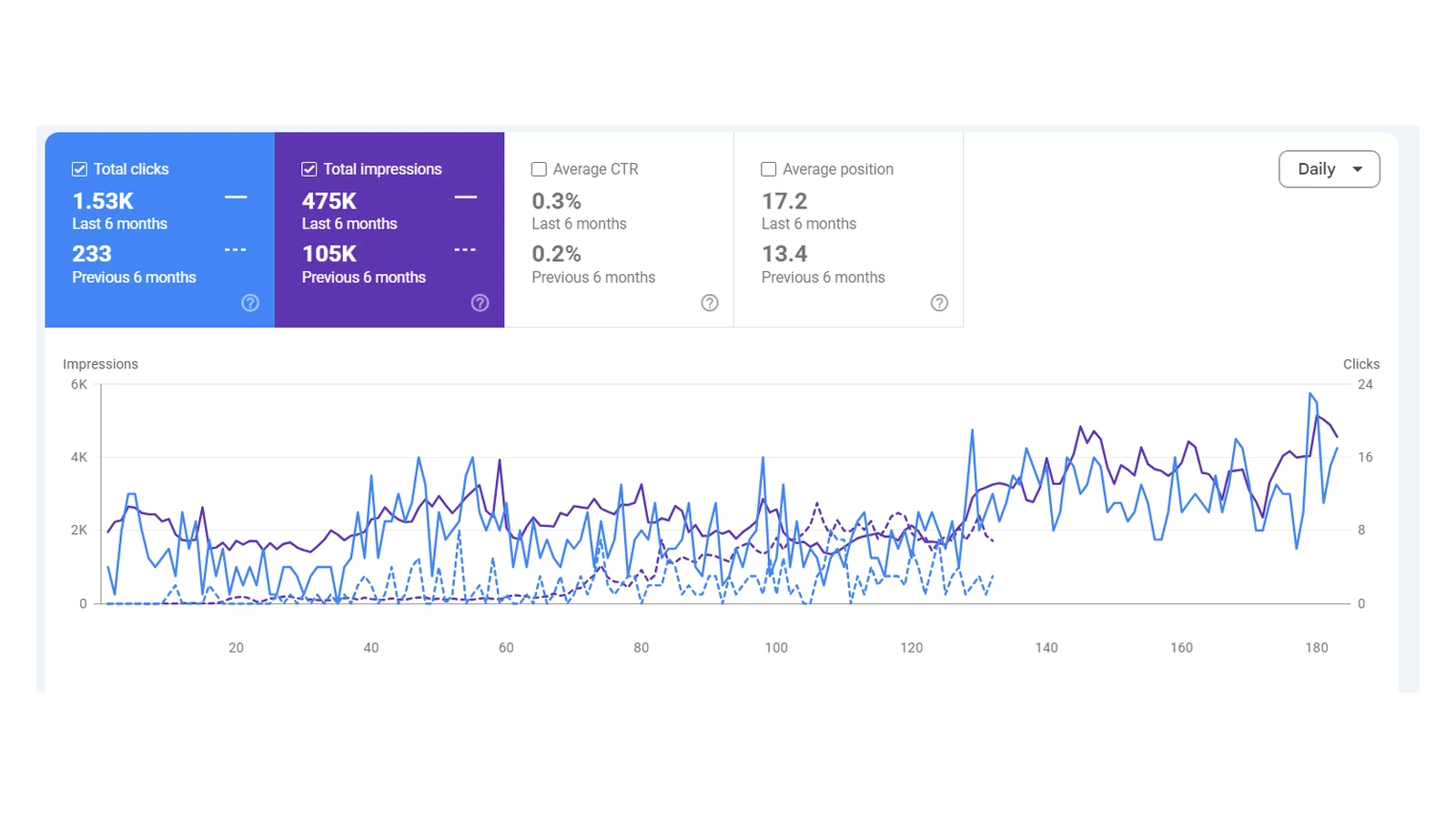
That has a practical effect: if your SEO is weak, your chances in AI Overviews are weak too. The same pages that rank well tend to be the ones AI Overviews can use. Clicks from AI Overviews are counted inside your normal Web search numbers in Search Console, so you can't separate them out yet.
How ChatGPT search chooses sources
OpenAI launched ChatGPT search in October 2024. It uses third-party search providers and content from news partners to find information, and shows links to its sources. To be found, your site should allow OAI-SearchBot in robots.txt and be indexed in the major search engines, including Bing.
ChatGPT also answers many questions from what the model already knows, without searching. That knowledge comes from its training data, so a brand that is described clearly and consistently across the web has a better chance of being named. Visits from ChatGPT usually arrive with chatgpt.com as the source in your analytics.
What we have seen in client work
These platforms are still new, so we don't have a large set of examples yet. But a few patterns are already clear:
- The two don't always agree. An IT services company we work with showed up in Google AI Overviews for its main topics but not in ChatGPT. An e-commerce client was the opposite: named in ChatGPT, but rarely in AI Overviews. Being visible in one says little about the other, so check both.
- Traffic is real but small. We see some visits from AI tools in client analytics, but not a lot. Most of it looks like research, and so far those visits have not turned into leads as well as normal search traffic does.
- FAQs make a visible difference. People bring questions to AI tools. Pages that answer those questions directly, with a real FAQ section, are picked up far more often than pages that only describe a service.
How people actually use each one
In our own work, the two tools get used for different jobs. For a quick personal search, AI Overviews is the default, because it is already there in Google. For deeper research about a business or an industry, we use both and compare the answers. For ad audiences, AI Overviews has been more useful: ChatGPT often suggests audience segments that sound right but don't exist as targeting options in the ad platforms.
Your buyers probably behave in a similar way. Quick questions go to Google. Longer research, comparisons and "help me decide" questions are more likely to go to ChatGPT.
Which matters more for your business?
Our view, and it is a view, not a certainty: for most small and B2B businesses, Google AI Overviews matters more right now. Google is still where most people start a search, and AI Overviews show up inside that habit. ChatGPT tends to name well-known brands, or businesses the user asks about directly, more often than smaller businesses it has to discover.
That will change as more buying research moves into chat tools. The good news is that most of the work helps both:
- Strong SEO basics, so your pages are indexed and trusted in Google and Bing
- Pages that answer real buyer questions directly, with FAQs. See how to structure content for AI answers
- Consistent brand facts and mentions on other sites. See how to improve brand visibility in AI search
- robots.txt that allows Googlebot, Bingbot and AI search bots
The most common mistake we see
Many businesses now try to do everything themselves with AI: research the market, write the pages, plan the campaign. AI is a good starting point, but it doesn't know your customers. We see the same thing in ads and in SEO: a plan drafted with AI and then corrected by someone with real experience works. A plan taken straight from AI usually doesn't. Use the tools to move faster, then apply what you know about your buyers before you publish or spend money.
How to check your visibility in both
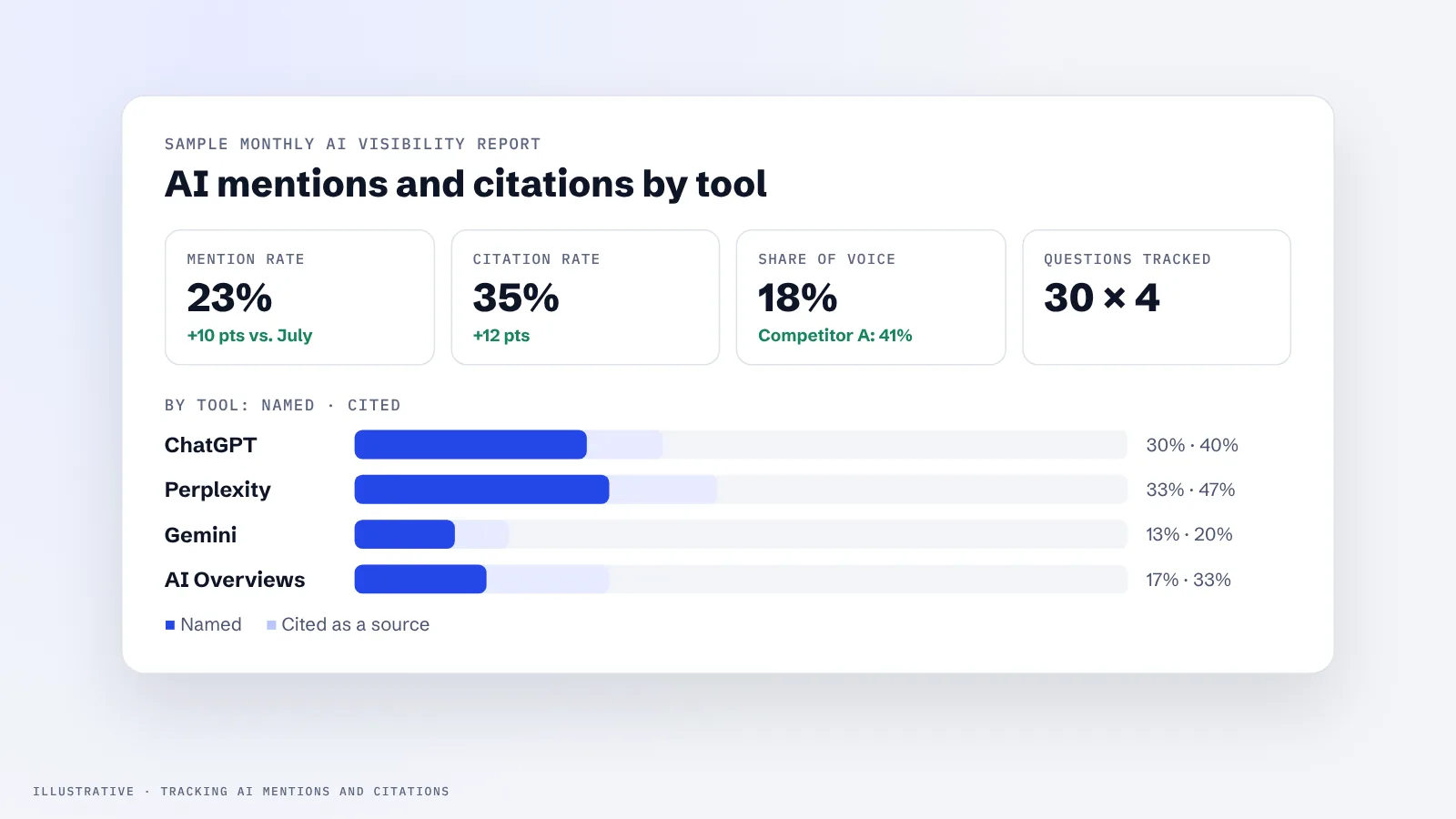
Write 15 to 30 questions your customers ask and run each one in Google and in ChatGPT, in a private window. Note whether you are named, whether your site is linked and which competitors and sources appear. Our free AI visibility prompt generator builds the question list and a tracking sheet for you. Our guide on how to measure AI search visibility explains how to read the results over time.
FAQ
What is the difference between AI Overviews and ChatGPT search?
AI Overviews are AI summaries shown at the top of Google search results, built from Google's index. ChatGPT search is a feature inside ChatGPT that searches the web through third-party providers and partner content to answer questions in a chat.
Do I need to optimize separately for AI Overviews and ChatGPT?
Mostly no. The same work helps both: strong SEO, pages that answer questions directly, consistent brand information and access for search and AI crawlers. The main extra step for ChatGPT is making sure OAI-SearchBot is allowed and your site is indexed in Bing.
Can I see AI Overviews traffic in Search Console?
Only as part of your total. Google includes clicks and impressions from AI Overviews and AI Mode in the Web search type of the Performance report, without a separate filter.
How do I track traffic from ChatGPT?
In GA4, look at sessions from the source chatgpt.com. You can group it with other AI sources, such as perplexity.ai and gemini.google.com, into a custom AI channel to see the trend in one place.
Is ChatGPT going to replace Google search?
Not soon, in our view. Google is still the starting point for most searches, and it is adding AI answers of its own. More research is moving into chat tools, though, so it makes sense to be visible in both.
Want to know whether Google AI Overviews and ChatGPT mention your business today? Our free AI visibility check runs your customers' questions through both, plus Perplexity and Gemini, and shows where you stand.