The short version
- AI Overviews and AI Mode build answers from indexed pages, so crawlability and indexing still decide eligibility.
- Simple factual queries lose the most clicks; commercial and local searches hold up better.
- Pages that state facts plainly and add original material are easier to cite.
- Track citations, accuracy and conversions alongside rankings and clicks.
Every few months someone declares that SEO is over, and AI Overviews and AI Mode have given that argument a second wind. What actually happens is less dramatic, and more useful to understand. AI-generated answers change how people use a results page and which visits you still earn. They still depend on the open web, and on the same signals that have always decided which content gets found, understood and trusted.
This article covers what the two features are, how pages end up as sources, what shifts in your traffic, and what we’d actually do first on a site that wants to stay visible.
What AI Overviews and AI Mode are
AI Overviews are generated summaries that appear at the top of some Google results pages, with links to the sources used. They show for a subset of queries, and the classic organic results still sit underneath.
AI Mode is a more conversational experience. Users ask a question, get a synthesized answer with source links, and keep going with follow-ups. A single session can cover what used to take five or six separate searches.
Both work in broadly the same way: retrieve relevant documents from Google’s index, then generate a response grounded in them. That retrieval step is the part SEOs should care about most.
How a page becomes a source
A generated answer can only cite what the system can find and read. In practice, a page needs to clear the same gates it always has:
- Crawlable. Not blocked in robots.txt, reachable through internal links, and returning a 200 status.
- Indexed. Not carrying a noindex tag, not canonicalized away to another URL, and judged worth keeping in the index.
- Renderable. Key content present in the HTML or reliably rendered. Facts that only appear after a click, inside a tab that loads late, or in an image are harder to use.
- Eligible for snippets. Snippet controls such as nosnippet and max-snippet limit how much of a page can be shown in results, and you should expect them to affect AI features too. Check your templates before you wonder why a page is never cited.
- Relevant and trusted. Of the pages that pass the first four gates, the ones that answer the specific question clearly and come from a credible source are the ones that get used.
None of this is new. It is why a technical SEO audit is still the first piece of AI search work we do on most sites.
What actually changes
Fewer clicks for simple questions
When a query has a short factual answer, many users get what they need without clicking. Definitions, quick how-tos and “what is” content that restates widely available facts are the most exposed. If a big share of your organic traffic comes from that kind of page, expect pressure there first.
Longer, more specific queries
Conversational interfaces encourage people to describe their situation: budget, team size, location, constraints, what they already tried. Content written for specific scenarios tends to match those questions better than a generic overview does. A page called “How to choose a CRM” is competing with everything. A page about choosing a CRM for a 10-person field sales team has a clearer job.
Citations become a visibility metric
Being cited inside an AI answer is a new kind of visibility. It doesn’t always produce a click, but it shapes which brands people remember and trust when they are ready to act. Treat it like an impression with a stronger endorsement attached.
The clicks you keep tend to be further along
Someone who reads a summary and still clicks through usually wants more depth, a comparison, a price, or a way to get in touch. Fewer visits can still mean more inquiries if the landing pages are built for that visitor.
AI search is still search, with a new front end. Crawling, indexing and trust still decide who gets seen.
What stays the same
- Technical accessibility. Pages must be crawlable, renderable and indexable. Google still uses mobile-first indexing, so the mobile version is the one that counts.
- Relevance. Content still needs to match what the searcher is trying to do.
- Trust. Expertise, accuracy and corroboration from other sources count for as much as ever, probably more, because a generated answer puts your claims next to everyone else’s.
- Commercial intent. Searches close to a purchase decision still lead to clicks, comparisons and inquiries. People rarely hire an agency or buy industrial equipment straight from a summary.
A quick way to triage your queries
To size the impact, sort your top queries and landing pages into groups and decide what each one needs. This is the grid we use.
| Query type | Example | Exposure to AI answers | What to do |
|---|---|---|---|
| Simple factual | “what is a canonical tag” | High | Keep the page accurate and concise; add something original or accept lower clicks |
| Complex informational | “how to migrate a store without losing rankings” | Medium | Go deeper: steps, edge cases, examples, your own experience |
| Comparison and evaluation | “shopify vs woocommerce for b2b” | Medium | Clear criteria, tables, the real trade-offs, a stated recommendation |
| Commercial and local | “seo agency for ecommerce”, “plumber near me” | Lower | Strong service pages with plain facts: who it’s for, process, pricing approach, locations, proof |
| Branded | “[your brand] reviews” | Varies | Make sure the facts about you are consistent everywhere they appear |
The point of the exercise is focus. Most businesses find their revenue sits in the bottom three rows, and those pages often need more attention than the blog posts everyone is worried about.
Worked example: rewriting a service page to be citable
Take a hypothetical B2B supplier whose main service page opens with two paragraphs about being “passionate about quality” and “trusted partners.” A generated answer has nothing to quote there. Neither does a buyer.
A rewrite would lead with the facts a buyer and a retrieval system both need:
- What the product range covers, in plain category names buyers actually use.
- Who it’s for: industries, order sizes, regions served.
- How ordering, delivery and minimums work.
- Certifications or standards met, stated once and accurately.
- A short FAQ answering the questions the sales team hears every week.
Every one of those points is a sentence that can be lifted into an answer and attributed to you. It also tends to convert better, because it removes the reasons people bounce.
Results from this kind of work are usually gradual on established sites. On a mature cleaning supplies store, clicks went from 5.72K to 6K (+4.9%) and impressions from 333K to 357K (+7.2%) over three months against the previous three, with average position moving from 9.4 to 9.1. That is steady compounding, and it is what a mature site should expect.
How to measure visibility now
Rankings alone no longer describe your visibility, but they’re still worth tracking. Add new measures next to them.
- Search Console trends. Watch impressions, clicks and CTR by page group. Rising impressions with flat clicks on informational pages is a pattern worth investigating.
- A prompt set. Write 30 to 50 questions your buyers really ask, across awareness, comparison and purchase. Check them monthly in AI Overviews, AI Mode and the assistants your audience uses. Record whether you’re cited, who else is, and whether the answer about you is accurate.
- Leads and revenue by landing page. This is the number that tells you whether lost clicks were valuable clicks.
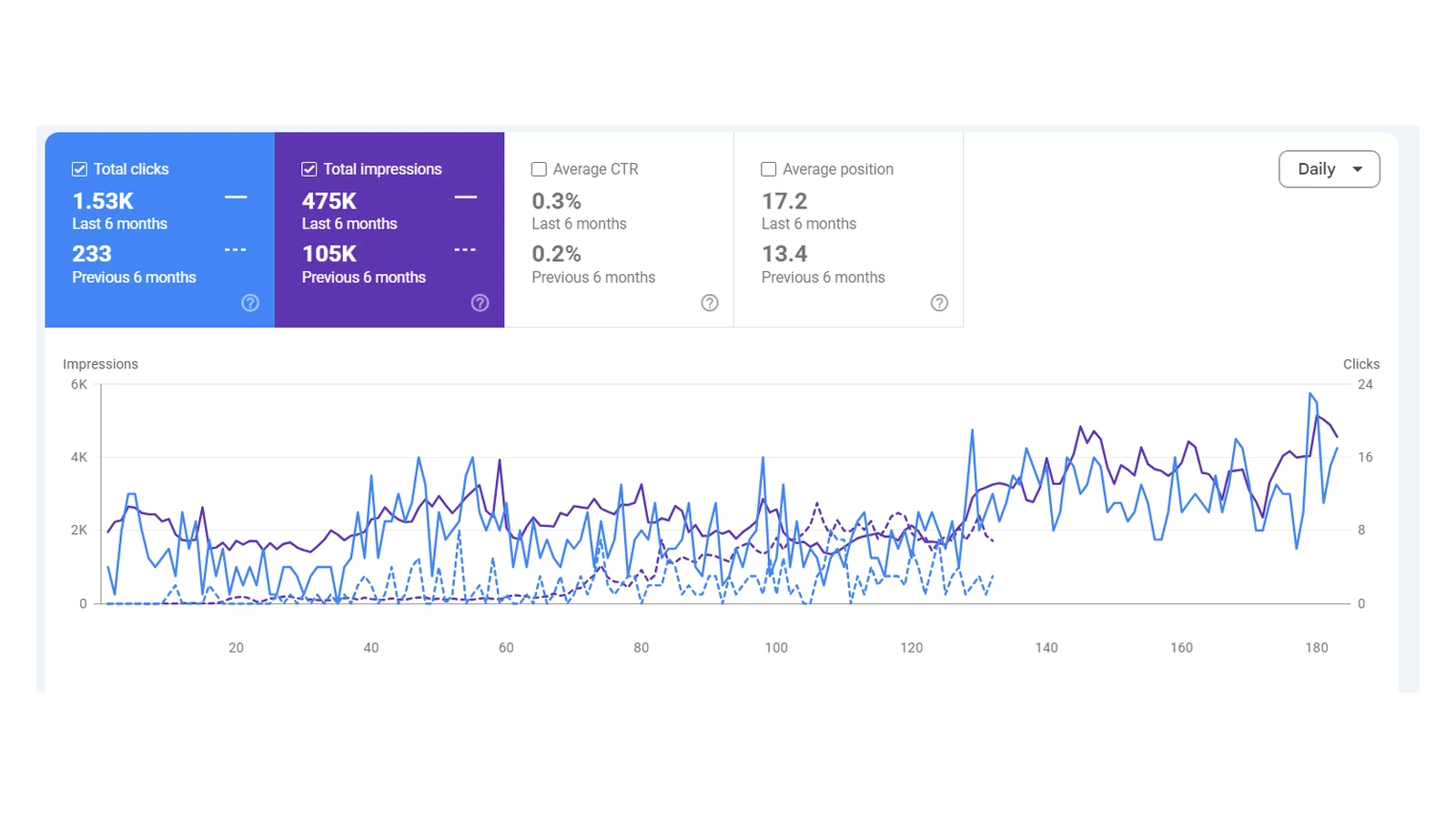
Read CTR carefully. On an outdoor and hobby e-commerce brand our team worked on, clicks rose 46.4% and impressions 72.6% over six months, while CTR fell from 1.8% to 1.5% and average position slipped from 8.3 to 9.2. The site was showing for far more queries, many of them further down the page. A falling CTR on its own told the wrong story.
What we’d do first
- Run the triage grid on your top 100 landing pages by clicks and by conversions.
- Fix crawl, indexing, rendering and snippet-control issues on the pages closest to revenue.
- Rewrite the top five service or category pages so the key facts are stated plainly near the top.
- Add original material where you can: your own data, process detail, pricing logic, named expert authors.
- Make your brand facts consistent across your site, Google Business Profile, directories and partner sites.
- Build the prompt set and take a baseline before changing anything else.
If you want help with this, it’s the core of our AI SEO work.
Common mistakes to avoid
- Chasing guaranteed placement. Nobody can promise inclusion in AI answers. Be wary of anyone who does.
- Mass-producing pages to “feed the AI.” Thin, near-duplicate pages hurt the whole site and rarely get cited.
- Hidden text aimed at language models. It is a spam tactic with a new label and can get you penalized.
- Abandoning informational content entirely. It still builds topical depth, earns links and supports the pages that convert.
- Judging success on clicks alone. Track citations, accuracy and conversions alongside traffic.
FAQ
Can I opt out of AI Overviews?
You can limit how your content is shown using snippet controls such as nosnippet, but these also affect your regular search snippets. For most businesses the trade-off isn’t worth it. Check Google’s current documentation before changing anything site-wide.
Do I need a separate strategy for AI Mode?
Mostly no. The same pages and signals feed both. The main difference is that AI Mode rewards content that handles follow-up questions, so cover the next three things a buyer would ask on the same page or one click away.
Does structured data get me into AI answers?
Structured data helps search engines understand a page and can make you eligible for rich results. It doesn’t guarantee citation. Use it where it accurately describes visible content and treat it as one input among many.
Should I stop writing blog posts?
Stop writing generic ones. Posts with original data, real examples or a clear point of view still earn visibility, links and citations. Rewrites of what the top ten results already say are the ones losing ground.