The short version
- Do the cost-per-customer math before choosing a channel.
- Ads suit urgent demand, launches and testing which terms convert.
- SEO suits expensive clicks, long research cycles and long-term cost.
- Most businesses run both; share data and judge search as one channel.
“Should we do SEO or Google Ads?” usually gets asked when the budget is tight and someone needs results this quarter. Both channels put you in front of people who are already searching for what you sell. They differ in how fast they work, how the costs behave over time, and what you own once you stop paying.
We run both for clients. This is the framework we use to decide which goes first and when to shift the mix.
How SEO and Google Ads differ
| Factor | SEO | Google Ads |
|---|---|---|
| Speed | Usually months before competitive commercial terms move | Traffic from the day campaigns go live |
| Cost model | Investment in technical work, content and authority, front-loaded | Pay per click, every click, for as long as you run |
| When you stop | Visibility usually fades gradually | Visibility stops the same day |
| Control | Indirect: you influence rankings, Google decides | Direct control of keywords, budgets, copy and landing pages |
| Feedback speed | Slow, with looser attribution | Fast, down to individual search terms |
| Trust | Organic results often carry more credibility with researchers | Labeled as sponsored, which some buyers skip |
| Ceiling | How many relevant queries you can realistically rank for | Budget, search volume and auction prices |
Put simply, Google Ads rents attention and SEO builds it. Renting is fast and flexible. Building is slow, and cheaper per visit once it works. Which one fits depends on your numbers.
The cost math most people skip
The decision often comes down to unit economics, so do the arithmetic before arguing about channels. A simple, hypothetical example for a service business:
- Average cost per click on core terms: $4
- Landing page conversion rate to inquiry: 5%
- Cost per inquiry: $4 ÷ 0.05 = $80
- Inquiry to customer rate: 25%
- Paid cost per customer: $80 ÷ 0.25 = $320
If a customer is worth $2,000 in gross profit, $320 is an easy yes and Ads should probably be running now. If a customer is worth $300, the channel loses money on every sale before you count management time, and SEO (or fixing the conversion rate) becomes the priority.
SEO has a cost too. You pay for audits, technical fixes, content and links before the traffic arrives, so the cost per visit starts high and falls as rankings build. The fair comparison is your expected cost per customer from organic over 12 to 24 months, set against what it would cost to buy the same customers through paid. Run that with your own numbers. Borrowed benchmarks from other industries will mislead you.
When Google Ads should come first
- You need inquiries or sales within weeks. Cash flow, a sales target or a launch date won’t wait for rankings.
- You’re launching something new. A new product, location, domain or website has no organic history. Ads cover the gap while SEO gets started.
- You don’t yet know which terms convert. A few weeks of search-term data shows which queries produce buyers. That’s cheaper than writing content for keywords that turn out to be research traffic.
- The results page is crowded with ads and marketplaces. For some commercial queries, the first organic result sits well below the fold on mobile. Paid may be the only way onto the top of the page.
- Your unit economics clearly work. If the math above shows healthy margin per customer, there’s little reason to wait.
When SEO should come first
- Clicks are expensive and margins are thin. Legal, finance, insurance and many B2B niches have click costs that make paid acquisition hard to sustain at scale.
- Buyers research for weeks before deciding. Long consideration cycles reward content that shows up across dozens of informational queries, which would be costly to buy one click at a time.
- You can wait a few months and want an asset. Organic visibility keeps working after the invoice is paid. Paid stops when the budget does.
- Your site has technical problems. Slow pages, broken templates and awkward mobile layouts drag down ad conversion rates as well. Fixing the site first makes every later channel cheaper.
- AI answers show up for your category. The sources cited in AI-generated answers come from organic content, and you can’t pay to be one of them.
A five-question decision framework
- How soon do you need revenue from search? Under three months points to Ads first. Six months or more gives SEO room to work.
- What does a customer cost through paid, and what are they worth? If paid acquisition is profitable, run it. If it isn’t, more budget won’t fix it.
- How do your buyers search? Short, urgent, high-intent queries (“emergency electrician near me”) suit Ads. Long research cycles (“how to choose an ERP for manufacturing”) suit SEO.
- What does the results page look like for your top ten terms? Search them on a phone. Count the ads, shopping units, map packs, AI answers and marketplace listings above the first organic result.
- What state is your site in? If it’s slow, thin or hard to crawl, neither channel will perform well until that’s fixed.
Score each answer toward Ads, SEO or neutral. Most end up with a clear lean one way and a reason to run some of the other.
Three worked examples
A new local service business
A plumbing company opens in a new city with no reviews and a fresh domain. Urgent searches like “blocked drain plumber” carry strong intent, and the business needs calls this month. We’d start with tightly targeted Search campaigns on emergency and high-intent terms, call tracking and a capped daily budget. In parallel: a complete Google Business Profile, a landing page per service area and a steady routine for collecting reviews. As map pack visibility grows, paid spend on terms where they now show up well can be tested downward.
A B2B software company with a long sales cycle
Click costs on the core category terms are high, deals take months, and buyers read comparisons, guides and pricing pages before they book a demo. Paying for every research click is expensive and hard to attribute. We’d put most of the budget into SEO: commercial pages, comparison content and technical health. A smaller Ads budget covers brand terms and demo-ready searches, plus a few competitor queries worth testing.
An e-commerce store with a large catalog
Here the answer is usually both from day one. Shopping and Performance Max campaigns sell products with good margins, while SEO works on category pages, faceted navigation and product content. See e-commerce SEO vs ads for that split.
What returns look like on each side
Two of our case studies show the different shapes. On the paid side, a food e-commerce account has run Google Ads from Q1 2020 to Q3 2026 across Demand Gen, Search, Shopping, Performance Max, brand and remarketing. It produced 18.4K purchases at 410.49% actual ROAS (about 4.10x) on ₹49.1L of spend. That’s a channel paying its way monthly, for as long as the budget runs.
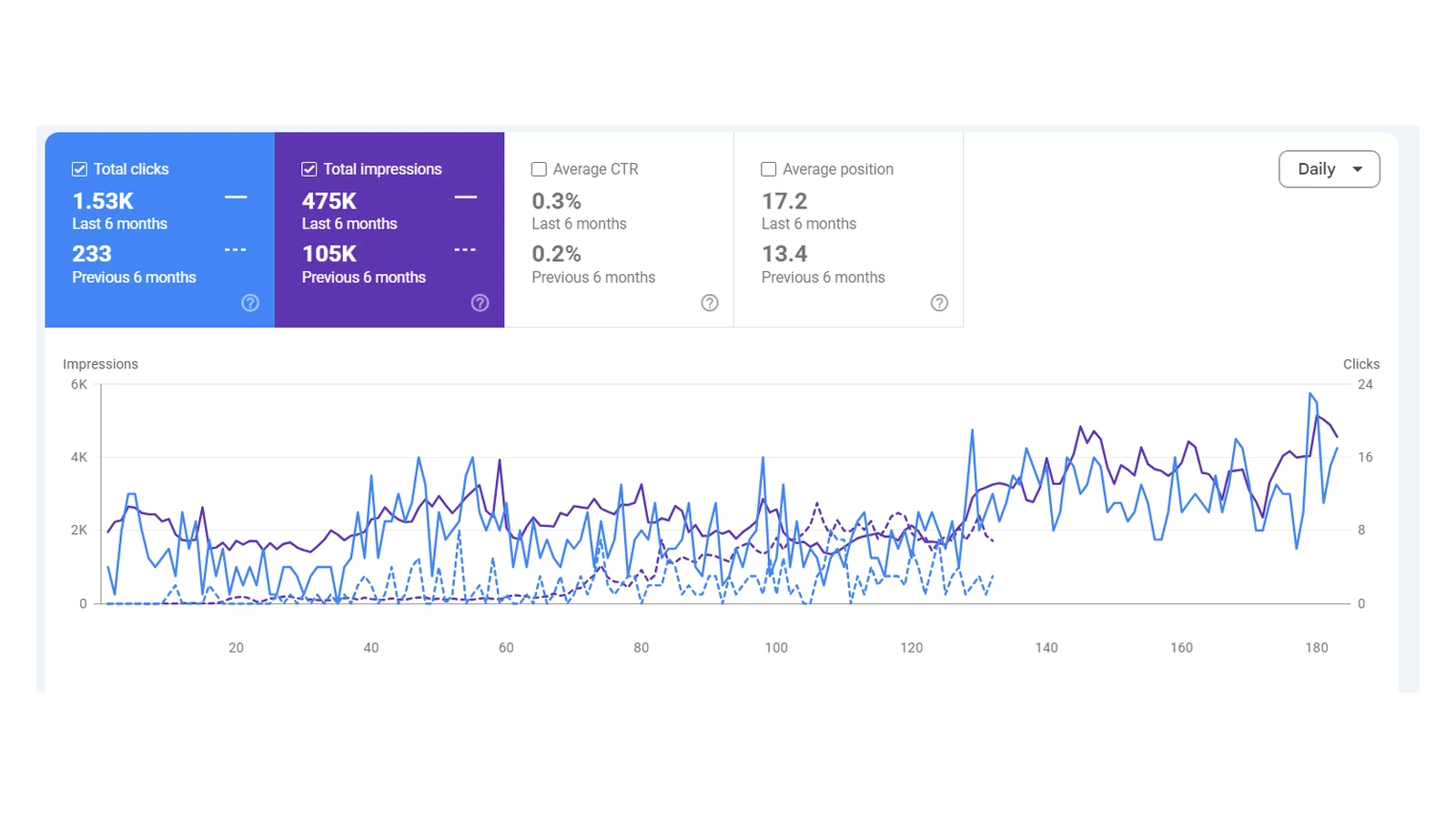
On the organic side, a travel business grew organic clicks from 233 to 1.53K (+557%) and impressions from 105K to 475K (+352%), comparing six months against the previous six in Google Search Console. Those clicks carry no per-click cost. These are different businesses with different starting points, and neither result is a promise for anyone else. What they show is how each channel tends to return value: paid in a steady, metered flow, organic in a curve that builds.
Running both well
Most businesses end up running both. The gains come from making the two channels share information.
- Use paid search-term data to plan SEO. Queries that already convert in Ads are safe commercial targets. Build or improve organic pages for them first.
- Build landing pages that serve both. A strong commercial page with clear proof, pricing signals and fast load times tends to rank better and convert paid traffic better.
- Test paid spend where you rank well. Where you hold a top organic position, reduce bids on that term in a controlled way and watch total clicks and conversions across paid and organic. Some terms lose little; others lose more because competitors take the ad slots.
- Keep brand campaigns in their own column. Brand search ads are cheap and often defend against competitors bidding on your name. Report them separately so they don’t flatter overall ROAS.
- Look at blended numbers. Judge search as one channel: total search revenue against total search cost, with paid and organic split out underneath.
Common mistakes
- Judging SEO on a six-week timeline. If you need results in six weeks, run Ads. Canceling SEO early wastes what you’ve already spent.
- Switching off Ads the moment rankings appear. Test reductions term by term. A first-page ranking doesn’t mean you own the click.
- Sending paid traffic to the homepage. Match each ad group to the most relevant page. Weak landing pages waste spend.
- Leaving broad match and automated campaigns unchecked. Review search terms regularly and add negatives.
- Writing content with no commercial path. Informational articles should link clearly to the pages that sell.
- Comparing channels on last-click data alone. Organic research often starts a purchase that a paid brand click finishes.
What we’d do first
- Pull the last 12 months of Search Console data and, if you have it, Google Ads search-term data.
- Work out paid cost per customer against customer value for your core terms.
- Search your top ten commercial terms on mobile and note everything above the first organic result.
- Run a quick technical check of the pages you’d send traffic to.
- Set a split: Ads for immediate demand where the economics work, SEO for terms where organic can realistically compete, reviewed every quarter.
If you’d like a second opinion on the split, our SEO and Google Ads teams work from the same data.
FAQ
Does running Google Ads improve organic rankings?
No. Google has long stated that advertising doesn’t influence organic rankings. Ads help SEO indirectly by showing which queries convert, so you know which pages to prioritize.
How long does SEO take compared with Google Ads?
Ads can send traffic as soon as campaigns are approved. SEO usually takes several months to move competitive commercial terms. Technical fixes on an established site can show sooner; a brand-new domain usually takes longer.
Should I stop bidding on my brand name if I already rank first?
Test it before deciding. If competitors bid on your brand, pausing can hand them clicks. If nobody else bids, brand ads may add little. Measure total brand clicks and conversions during the test.
What budget split should I start with?
There’s no standard ratio. Start from timeline and unit economics: fund Ads up to the point where cost per customer stays profitable, then put the remaining search budget into SEO work on the terms paid can’t serve affordably.