
E-commerce SEO case study
Expanding Organic Search Visibility for a Cleaning Supplies E-commerce Business
A B2B and B2C e-commerce SEO case study for an established cleaning and hygiene supplies store that sells to businesses and households: protect the rankings it already had, then reach more searches.
- Business
- Cleaning & hygiene supplies business (name withheld)
- Model
- B2B and B2C e-commerce, products and services
- Measured
- Last 3 months vs previous 3 months
6.0K
Google Search Console clicks during the latest three-month period.
357K
Search impressions recorded during the latest three-month period.
+7.2%
Compared with the previous three-month period.
9.1
Improved from 9.4 in the previous three months.
Source: Google Search Console, last 3 months vs previous 3 months. Clicks rose 4.9% and CTR held at 1.7%. The business isn’t named.
The business
A supplier selling to businesses and households
The business sells cleaning and hygiene products online to companies and to households, alongside hygiene services and equipment rentals for workplaces. Trade buyers such as offices, facilities and hospitality businesses order regularly and in volume; household customers usually buy a few products at a time.
So buyers arrive by several different routes, and each one should lead somewhere useful:
- Business need
- Product search
- Category
- Service or rental
- Inquiry or order
The starting point
Where we started: an established channel
Organic search was already working. The Search Console baseline for the previous three months was 5.72K clicks, 333K impressions, a 1.7% CTR and an average position of 9.4.
There was no reason to rebuild from scratch. The plan was to keep what already performed, then widen the range of searches the business appeared for.
The challenge
What needed attention
Protecting existing performance
An established channel can’t be put at risk by changes made to grow it.
Large product catalog
Many products and categories need a structure search engines understand consistently.
Two kinds of buyer
Businesses search for bulk supply, services and rentals; households search for single products.
Products and services together
Product categories, hygiene services and rentals all need to be found.
Category competition
Similar pages can compete with each other for the same searches.
Long-tail coverage
Specific product and trade searches add up in a broad catalog.
Beyond branded demand
Grow visibility with buyers who don’t yet know the business.
Goals
What success looked like
- Maintain existing organic clicks and click-through rate
- Expand search impressions and keyword coverage
- Hold or improve average position
- Support product, service and rental discovery
- Reach more business and household buyers beyond branded demand
Revenue, orders, leads and conversion rate aren’t reported because those figures weren’t provided. Only search metrics are shown.
The strategy
Growing coverage while keeping existing rankings
For a mature site, the biggest risk is breaking what already works. The strategy protected existing rankings first, then expanded coverage across categories, services, and both trade and household searches.
- Protect existing rankings
- Technical health
- Category strength
- Buyer intent
- Content
- Internal linking
- Wider visibility
What we did
Seven workstreams
What was done, and why a supplier with a large catalog and two kinds of buyer needed it.
Technical SEO
With a large catalog, the first job is making sure nothing that already ranks is lost to crawl, index or duplication problems.
- Crawlability and indexability
- Site architecture
- Canonicalization
- Metadata
- Technical page quality
- Duplicate and thin page review
E-commerce SEO
Category pages were treated as the main targets for commercial searches, with product pages capturing more specific intent.
- Category page optimization
- Product page relevance
- Collection and catalog structure
- Commercial search intent
- Product discovery paths
On-page SEO
Each page was matched to the searches it should answer, so categories, products and service pages didn’t compete.
- Titles and meta descriptions
- Heading structure
- Page relevance and semantic coverage
- Matching each page to its search intent
Business and household search intent
A facilities manager and a household shopper search for the same products in different ways. Trade pages were written for bulk, service and rental searches, while product pages served people buying for home.
- Bulk and trade supply searches
- Service and rental searches
- Home and workplace needs
- Product comparison queries
Content SEO
Supporting content covered the questions buyers ask before they choose a product or service, and pointed them to the right pages.
- Home and workplace hygiene topics
- Cleaning and washroom guidance
- Product selection and use
- Service-related questions
Internal linking
Categories, products, services and content were connected, so authority and buyers flow to the category, product and service pages that make sales.
- Content
- Category
- Product
- Service
- Related content
Authority and off-page SEO
Authority building ran alongside the on-site work, focused on relevance to cleaning, hygiene and the trade.
Search architecture
How products, services and content fit together
Product categories
- Hygiene products
- Cleaning chemicals
- Washroom supplies
- Dispensers
- Paper products
- Cleaning equipment
Services and trade pages
- Hygiene services
- Equipment rentals
- Bulk and trade supply
- Home and workplace needs
- Supporting content
Google Search Console
Clicks held up and visibility grew
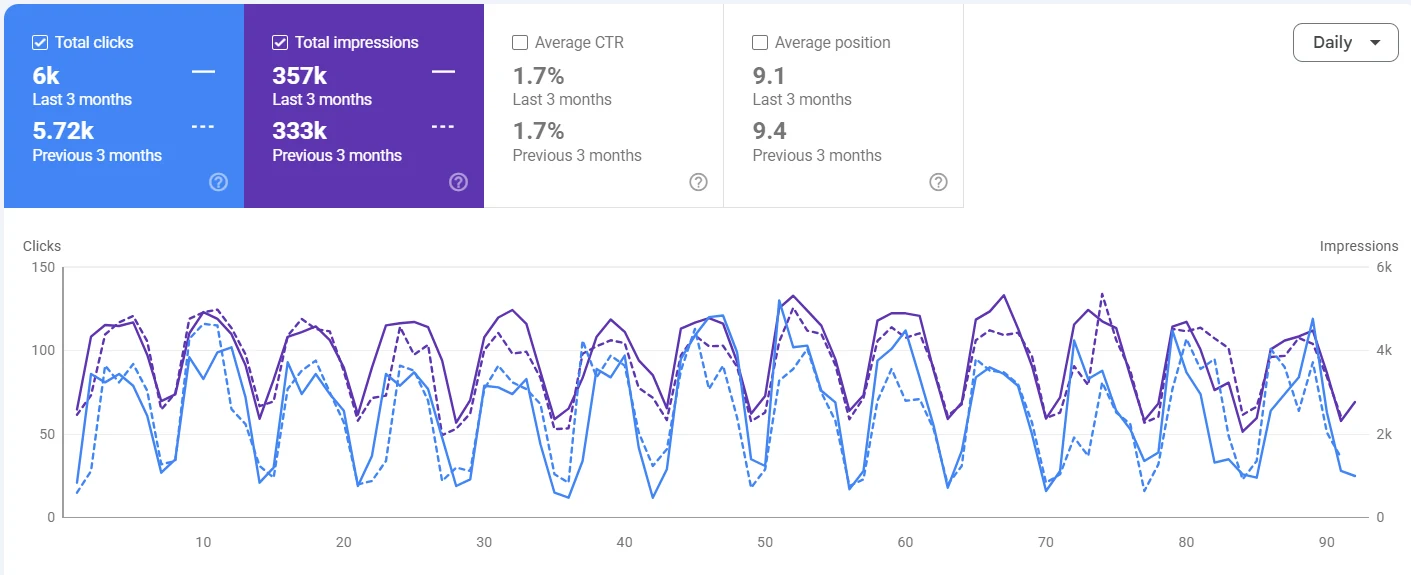
Last 3 months: 6K clicks, 357K impressions, 1.7% CTR, average position 9.1. Previous 3 months: 5.72K clicks, 333K impressions, 1.7% CTR, average position 9.4.
Analysis
What changed in organic search
- Clicks: 5.72K → 6K. About +4.9%.
- Impressions: 333K → 357K. About +7.2%.
- CTR: 1.7% → 1.7%. Stable.
- Average position: 9.4 → 9.1. Improved by 0.3.
These are modest, steady gains on an already healthy base. Impressions grew while CTR held and average position improved slightly, so the extra visibility came from searches that still fit the business. The weekly pattern in the chart comes from trade buyers, who search more on working days.
Semrush
A strong organic search footprint
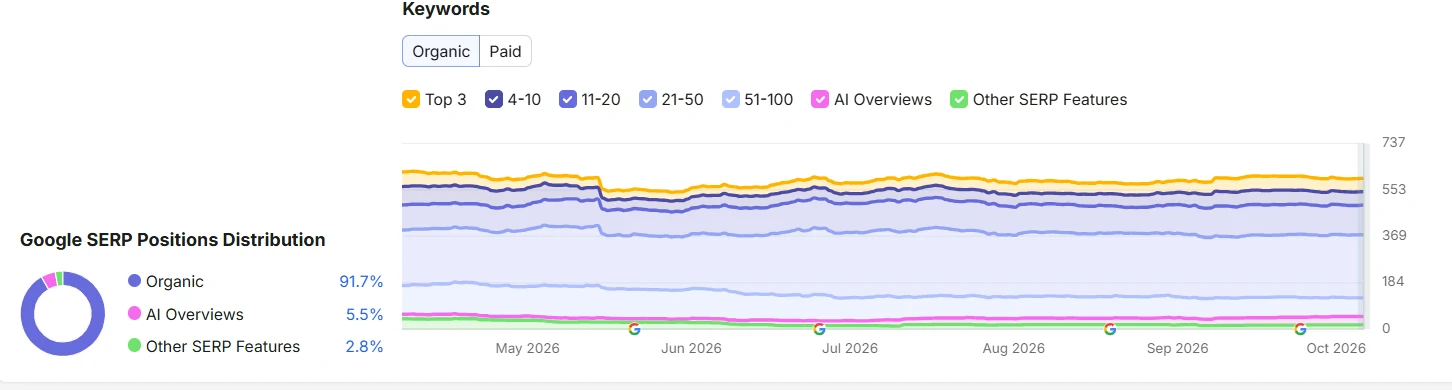
Semrush shows a broadly steady organic keyword footprint of roughly 550 to 600 tracked keywords through the period. Organic listings account for 91.7% of the tracked SERP position distribution, AI Overviews 5.5% and other SERP features 2.8%. These are shares of tracked positions, not shares of traffic.
Market
SEO built around two kinds of buyer
Businesses search for cleaning supplies, washroom solutions, hygiene services and equipment rentals, often with a bulk or local angle. B2B e-commerce SEO got the most attention here, because trade searches bring repeat orders. Households search for specific products and compare options before buying, so the B2C e-commerce SEO work made sure product pages still served people buying for home.
Before and after
Organic search performance, before and after
| Metric | Previous 3 months | Last 3 months | Change |
|---|---|---|---|
| Clicks | 5.72K | 6.0K | +4.9% |
| Impressions | 333K | 357K | +7.2% |
| CTR | 1.7% | 1.7% | Stable |
| Average position | 9.4 | 9.1 | Improved by 0.3 |
Source: Google Search Console, last 3 months against the previous 3 months.
The lesson
SEO growth also means protecting what already works
For an established business, the most valuable SEO work is often undramatic: keeping a strong channel strong while steadily widening the searches it reaches.
On this site that meant adding coverage for categories, services, trade and household searches one step at a time, and checking existing rankings after each change.
Services used
SEO services behind the results
- E-commerce SEO
- B2B SEO
- Technical SEO
- On-page SEO
- Content SEO
- Internal linking
- SEO consulting & strategy
- Off-page SEO
Related
Related SEO services
See also SEO for B2B and industrial companies or all case studies.
Can your store grow without losing the rankings it has?
Growth on a mature site starts with protecting what already ranks. The right SEO strategy widens coverage across products, services and buyer intent without putting existing performance at risk.