The short version
- GEO aims for inclusion and citation in generated answers; SEO aims for rankings and clicks.
- Both depend on crawlable, relevant, trustworthy content, so most of the work is shared.
- GEO adds entity consistency, citable specifics, corroboration and prompt-level tracking.
- Fix crawling, indexing and thin pages first. Then add GEO to the same program.
Generative Engine Optimization (GEO) is one of the most talked-about terms in search right now, and some people pitch it as SEO’s replacement. We see it as an extension of SEO for results pages that write answers as well as list links.
The difference matters for budgets. Treat GEO as a separate discipline and you can end up paying twice for the same work, or pulling money away from the crawling, indexing and content work GEO depends on. Below we compare the two, show where the work overlaps and suggest how to decide what to do next.
Definitions
SEO (search engine optimization) improves how a website is discovered, understood and ranked by search engines, with the goal of earning qualified visits.
GEO (generative engine optimization) improves how a brand and its content are used by generative systems when they compose answers. That includes Google’s AI Overviews and AI Mode, and assistants such as ChatGPT, Gemini and Perplexity. You’ll also see it called AI SEO, answer engine optimization or LLM SEO. Whatever the label, the work is mostly the same.
Side-by-side
| Dimension | SEO | GEO |
|---|---|---|
| Primary outcome | Rankings and clicks | Inclusion and citation in generated answers |
| Unit of optimization | Pages and queries | Entities, facts and sources |
| Key inputs | Technical health, relevance, authority | Same, plus consistent entity data and corroboration |
| Where it shows up | Organic results, rich results, local pack | AI Overviews, AI Mode, chat assistants |
| Query shape | Short to mid-length keywords | Longer, conversational, multi-step questions |
| Measurement | Rankings, traffic, conversions | Prompt-level mentions, citations, accuracy |
| Maturity of tools | Established and well tested | Early; expect manual checks and noisy data |
Where they overlap
Most of the work is shared. Systems that ground their answers in web content have to find and read that content first. Google’s AI features draw on its search index, and other assistants use their own crawlers or search partners. Either way, a site needs to be accessible, deep on its topics and well linked.
A site with indexing problems, slow rendering or thin content won’t do well in either. In our experience, the sites cited most often were already doing SEO properly. They had a clear structure, a specific page for each need and evidence behind their claims.
Work that serves both:
- Crawlable, indexable pages with clean canonicals and sensible internal linking.
- Content that matches search intent and covers a topic in depth.
- Authority signals: links, mentions, reviews and recognizable expertise.
- Fast, stable pages. Core Web Vitals (LCP, INP and CLS) still describe the experience a visitor gets when they do click.
Where GEO adds something new
Entity consistency
Generative systems try to work out what your brand is: what you sell, who you serve, where you operate, who runs it. If your site says one thing, your Google Business Profile another and an old directory listing a third, the answer about you gets vague or wrong. GEO puts more weight on describing your brand, products and people the same way everywhere.
Citable specifics
Answers are built from sentences that can be lifted and attributed. Pages full of general claims give the system nothing to use. Pages with clear definitions, numbers, steps, criteria and comparisons do.
Corroboration
What you say about yourself carries more weight when independent sources say the same thing. Reviews, industry publications, partner pages and forum discussions all feed into how assistants describe you.
Prompt-level measurement
SEO tracks keywords. GEO tracks how assistants answer real buyer questions over time: whether you’re mentioned, whether you’re cited with a link, and whether what they say is accurate.
Where to put your effort
The right split depends on how healthy your SEO already is. Use this as a starting point.
| Your situation | Priority | Rough effort split |
|---|---|---|
| Indexing or technical problems, thin key pages | Fix indexing and technical issues first | Almost all SEO |
| Solid technical base, weak content depth | Build topic coverage with citable specifics | Mostly SEO, written GEO-ready |
| Healthy SEO, ranking well, little AI visibility | Add the GEO layer | Even split |
| Strong in both, competitive category | Corroboration, original data, measurement | Ongoing, as one program |
If you’re unsure which row you’re in, a technical SEO audit will usually tell you within a week.
Worked example: one page, two versions
Imagine a hypothetical managed IT provider with a services page called “Cybersecurity Services.” The original version reads: “We offer best-in-class cybersecurity solutions built around your business needs, delivered by experienced professionals.” It might rank on brand strength. It gives an assistant nothing to cite.
A version written for both SEO and GEO would include:
- A one-sentence definition of what the service covers, using the terms buyers search for.
- Who it suits: company size, sectors, compliance needs.
- What’s included, as a list: monitoring hours, response process, reporting frequency.
- How pricing is structured, even if exact prices aren’t published.
- Named people responsible, with relevant credentials.
- Three or four FAQs drawn from sales calls.
Nothing in that list is a “GEO trick.” Each item makes the page more useful to a buyer, and we keep seeing the same thing happen: work that gets a page cited also helps it rank and convert.
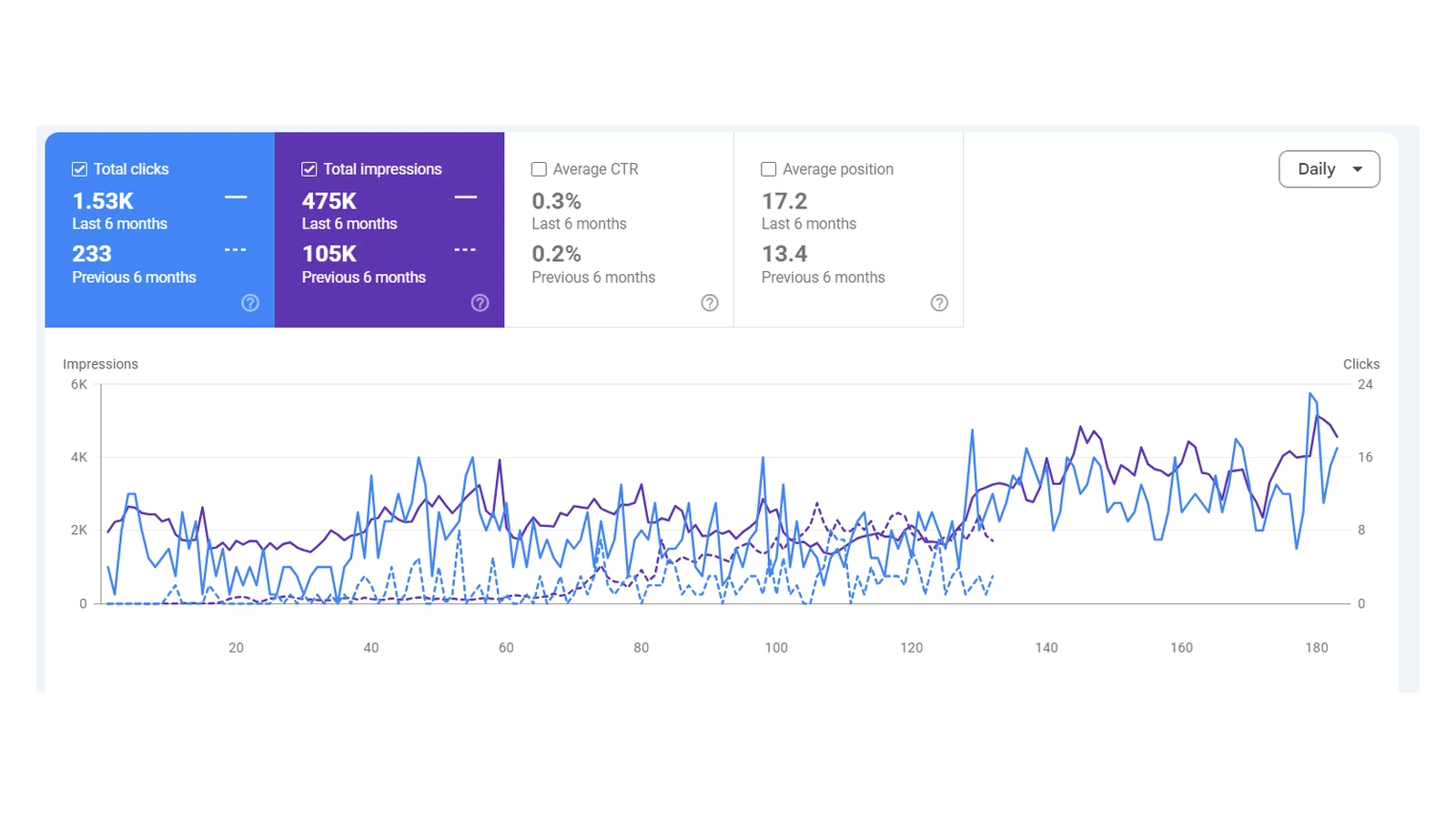
Good fundamentals compound. On a travel business we worked with, organic clicks went from 233 to 1.53K (+557%) and impressions from 105K to 475K (+352%), comparing six months against the previous six in Google Search Console. All of that came from standard SEO work, the same base GEO needs.
A practical GEO checklist
- Write a single, consistent description of your brand: what you do, for whom, where. Use it on your About page, profiles and directories.
- Audit your top 20 pages for vague claims and replace them with specifics.
- Add structured data where it accurately reflects visible content: Organization, Product, LocalBusiness, FAQ where appropriate.
- Put key facts in the HTML. Anything hidden behind scripts, tabs or images is easy to miss.
- Publish something original: data from your own work, a clear methodology, a documented process.
- Earn mentions on independent sites your buyers read.
- Build a prompt set of 30 to 50 buyer questions and check it monthly.
- Correct inaccuracies at the source. If an assistant gets your service area wrong, find where that information came from.
Common mistakes
- Hiring separate teams for SEO and GEO. They end up duplicating audits and arguing about the same pages.
- Skipping the technical basics. No amount of entity work fixes a site that isn’t indexed properly.
- Publishing AI-generated pages at scale. Thin content rarely gets cited and can drag down the rest of the site.
- Trusting a single prompt check. Generated answers vary between runs, users and days. Look at trends across many prompts.
- Believing guarantees. No one controls what a generative system says. Anyone promising placement is guessing.
What we’d do first
If the site has indexing problems, thin key pages or a messy structure, fix those first, because GEO depends on them. If the basics are solid, add a GEO layer in this order: audit entity consistency, upgrade your most commercial pages with specific, citable information, then start measuring visibility in AI answers so you have a baseline. Run it all as one program with one roadmap. That is how we approach GEO for clients.
For more on how Google’s AI features change click behavior, see AI Overviews and AI Mode: what changes for SEO.
FAQ
Is GEO replacing SEO?
No. Generative answers rely on content that has been crawled and indexed, and plenty of searches still end in a click. GEO extends SEO into a new set of surfaces.
How long does GEO take to show results?
It depends on your starting point and how often the systems refresh what they know. Changes to your own pages can be picked up as soon as they’re recrawled. Shifts in how assistants describe your brand usually take longer because they depend on third-party sources too.
Can a small business do GEO?
Yes. A consistent business description, specific service pages, an up-to-date Google Business Profile and real reviews cover a lot of ground for a local or niche business.
Which tools should I use to track GEO?
Tools in this area are still young. A manual prompt set in a spreadsheet, checked monthly, is a reasonable start. Add a tool once you know which questions you care about.