The short version
- In-house teams bring business context and pull with developers.
- Specialist partners bring breadth, depth and an outside view.
- Hybrid models suit most growing businesses.
- Map skills gaps first, compare true costs, and name one internal owner.
Sooner or later every growing business asks whether SEO should sit in-house, with an outside partner, or with both. There’s no single right answer, but the signals are usually clear once you look at the work itself, the skills you already have and the real cost of each option.
What SEO work actually involves
Before comparing models, list the work. SEO covers six fairly different skill sets:
- Technical SEO: crawling, indexing, site architecture, rendering, Core Web Vitals (LCP, INP, CLS), structured data and migrations.
- Content and on-page: keyword research, search intent, page briefs, writing, internal linking and refreshing pages that have slipped.
- Authority: digital PR, partnerships and earning links and mentions from sites your buyers trust.
- Analytics: Search Console, analytics setup, conversion tracking and reporting that ties rankings to revenue.
- AI search: visibility in AI Overviews and assistant answers, which draws on clear, well-structured, citable content.
- Project management: getting tickets into the development backlog, briefing writers and keeping stakeholders informed.
One person rarely covers all six at the same depth. That fact drives most of the decision.
The case for in-house
An in-house specialist knows your product, customers and internal politics. They sit in the planning meetings where site changes are decided, so SEO gets considered before a redesign ships. They can turn small fixes around in a day and focus all their attention on one business.
The weaknesses are breadth and continuity. A strong content strategist may be out of their depth on a JavaScript rendering problem, and a technical specialist may not enjoy writing briefs. When that one person leaves, much of the knowledge leaves with them, and rehiring can take months.
The case for a specialist partner
A specialist team has seen many sites, many algorithm updates and many migrations. It can cover technical, content, authority and analytics with different people who each go deep. It ramps up faster than a hiring process, and it can tell you uncomfortable things your own team may hesitate to raise.
The risks are distance and dependence. An outside team knows less about your product and has less pull with your developers. Some agencies also run a standard package regardless of what the site needs. Good partners reduce both risks with close collaboration, direct access to your team and clear ownership of data and accounts.
The hybrid model
Most growing businesses end up somewhere in the middle. The common versions:
- In-house owner plus specialist partner. One internal person owns SEO and priorities; the partner supplies technical depth, content capacity or digital PR.
- Advisory retainer. Your team does the work, and a senior SEO consultant sets direction, reviews output and catches problems early.
- Project-based support. You bring in specialists for discrete jobs such as a technical SEO audit, a site migration or an international rollout, then hand back to the internal team.
Side-by-side comparison
| Factor | In-house | Agency | Hybrid |
|---|---|---|---|
| Business context | Deep | Builds over time | Deep, via the internal owner |
| Time to start | Months, including hiring and ramp-up | Weeks | Weeks, if the owner is already in place |
| Breadth of skills | Limited by headcount | Wide | Wide where it counts |
| Influence on developers | Strong | Depends on access | Strong |
| Outside perspective | Low | High | High |
| Continuity risk | High if one person holds the knowledge | Lower, spread across a team | Lower |
| Cost structure | Fixed: salary, tools, management | Fees, flexible by scope | Mixed |
Compare the true cost
Most comparisons set one salary against one agency retainer. That understates the in-house side. A fair comparison includes:
- Salary, benefits and payroll costs.
- Recruitment fees or the internal time spent hiring.
- Tools: a crawler, rank tracking, keyword research, log analysis and reporting software.
- Training and conferences to keep skills current.
- Management time from whoever the specialist reports to.
- Ramp-up: the months before a new hire is fully productive.
- Content, development and PR budgets the specialist needs to get anything done.
The agency side has hidden costs too. Someone internal still has to brief the partner, approve work and get changes through development. If nobody owns that, even an excellent agency will stall. Budget a few hours a week of internal time either way.
How to decide: a skills-gap exercise
Decide based on skills gaps first and headcount second. List the six areas above and score your current team on each from 0 (nobody can do this) to 3 (we do this well today). Then mark which areas your site depends on most.
- Large, technical or international sites lean heavily on technical SEO, migrations and crawl management. If you score low there, bring in specialist depth.
- Content-led businesses need steady publishing and editorial judgment. An in-house content lead with outside technical support often works well.
- Local and small businesses rarely justify a full-time hire. A focused partner or consultant usually costs less than a salary.
- Businesses that need results quickly get moving faster with an established team than with a hiring process.
Where your gaps line up with what the site needs most, that’s where outside help pays off. Where you already score well, keep the work in-house.
What usually fits at each stage
Early stage
Limited budget, a small site and a founder or marketer wearing several hats. A consultant or small partner for setup, a technical baseline and a content plan is usually the best use of money. Hiring a full-time specialist this early often leaves them without the content and development support to make progress.
Growth stage
SEO is producing revenue and the backlog is growing. Hybrid models tend to work best here. Hire an internal owner, and keep a partner for technical work, extra content capacity or authority building.
Enterprise
Large sites with several teams, markets and platforms usually need an in-house SEO team with direct influence on product and engineering, plus specialists for audits, migrations and independent review.
How to choose a partner
If you go external, ask direct questions:
- Who will actually do the work, and how senior are they?
- What would you do in the first 90 days on our site, and why?
- How do you report, and how do you connect SEO to leads or revenue?
- Do we own all accounts, data, content and tools access?
- How do you work with our developers and writers?
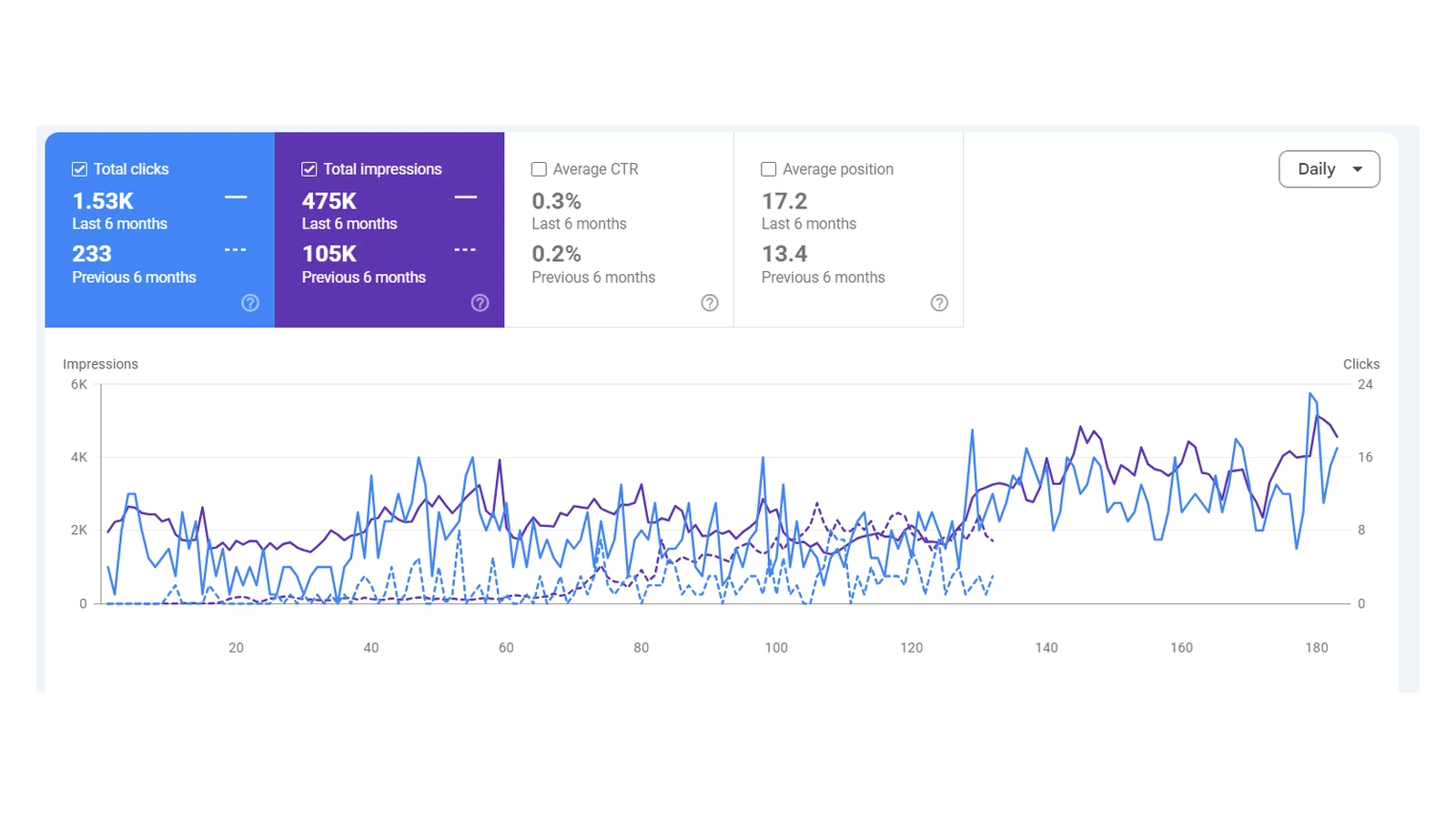
Treat guaranteed rankings, bulk link packages, vague monthly reports and reluctance to give you account access as red flags. Ask how they set expectations too. Mature sites usually grow in small steps. One cleaning supplies store our team worked on grew clicks from 5.72K to 6K (+4.9%) and impressions from 333K to 357K (+7.2%) over three months against the previous three, with average position moving from 9.4 to 9.1. A partner who explains why that kind of progress is worthwhile is more useful than one who promises hockey sticks. Our approach is laid out in how we do SEO.
Making any model work
- One named owner. Someone internal is accountable for SEO priorities, even if most of the work is external.
- A shared roadmap. One prioritized list, visible to marketing, development and the partner.
- Development access. SEO tickets go into the real backlog with an agreed process for priority.
- You own the data. Search Console, analytics, ad accounts and tools sit under logins your business owns.
- Regular reviews. Monthly reporting on progress, and a quarterly check on whether the model still fits.
Common mistakes
- Hiring one junior generalist and expecting them to cover technical, content, links and analytics.
- Outsourcing SEO with nobody internal to approve work or push fixes through development.
- Choosing a partner on monthly price alone, without comparing their plans for your site.
- Letting the agency hold your accounts, so leaving means losing history.
- Switching models every six months before any approach has had time to show results.
What we’d do first
- List the SEO work your site needs over the next 12 months.
- Score your team’s skills against it, and be strict about it.
- Price the full cost of a hire, including tools, management and ramp-up.
- Get one or two partner proposals for the gaps, with a 90-day plan.
- Decide who internally owns SEO, whatever model you pick.
FAQ
When does it make sense to hire a full-time SEO?
When SEO is a primary growth channel, the site is large or changes often, and there’s enough content and development budget for that person to execute. Without that support, a hire often stalls.
Can a freelancer replace an agency?
For a focused scope, often yes. A good freelancer can be excellent in one or two areas. For work that spans technical, content and authority at the same time, you may need several freelancers or a team.
How long should we give an agency before judging results?
Judge the first few months on whether agreed work ships and leading indicators like indexing and impressions improve. Traffic and revenue usually take longer, depending on the site’s starting point and competition.
We’re an agency. What if we need SEO capacity for our own clients?
That’s a different model again: outsourced delivery under your brand. Our white-label SEO service covers it.