The short version
- Impressions usually appear in the first month; clicks in month one to three; strong results around months eight to ten.
- Local SEO moves fastest. New domains in crowded markets take longest.
- An old site with bad past work can take longer than a new one, because the damage has to be cleaned up first.
- In the first three months, judge progress by work done and impressions, not by leads.
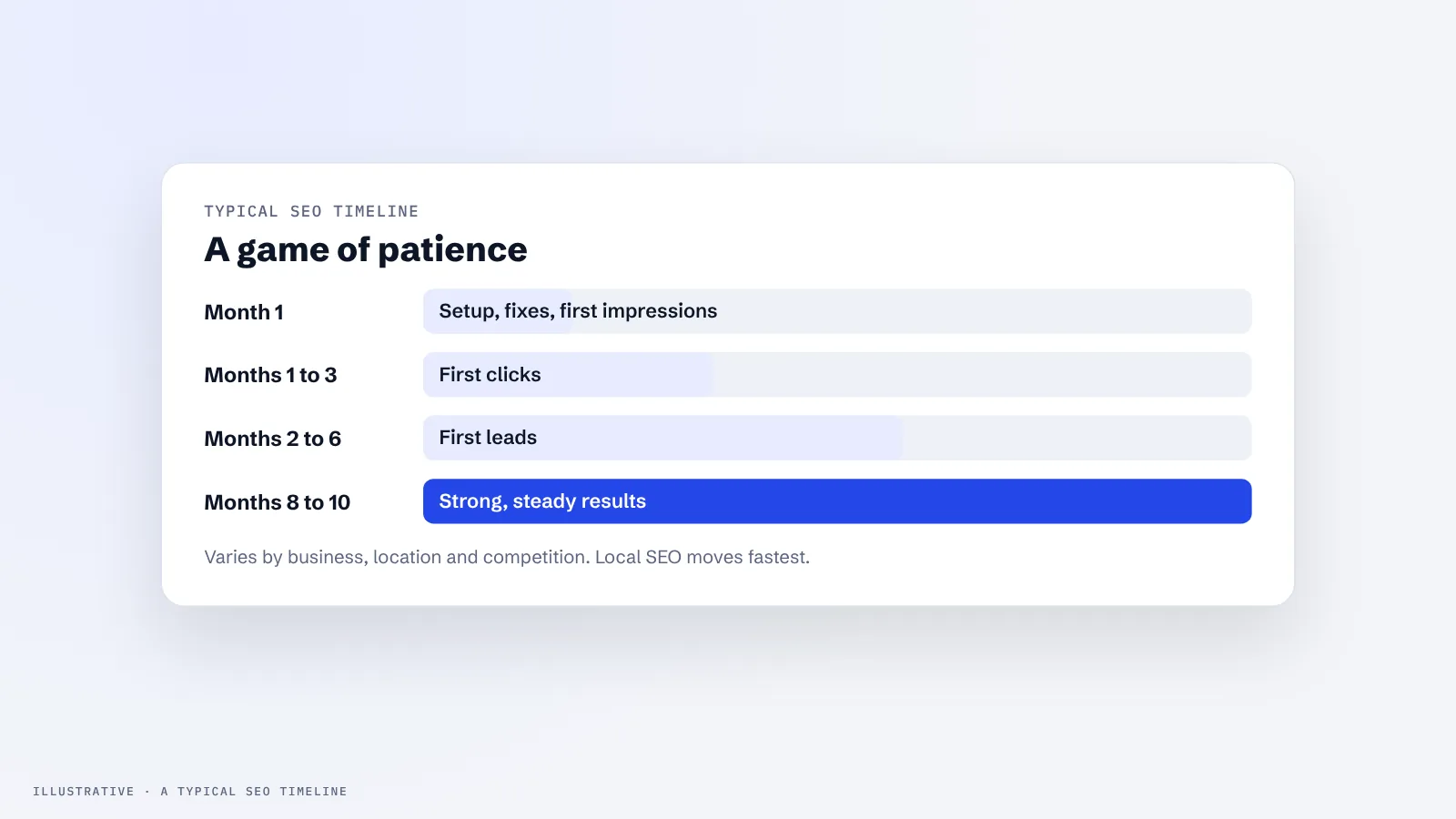
SEO usually takes several months to show real results. In our projects, impressions start in the first month, clicks arrive anywhere from month one to month three, and strong, steady results take around eight to ten months. Local SEO moves faster. A new website in a crowded market takes the longest.
Google itself says the same thing in its own advice on how to hire an SEO: an SEO will usually need four months to a year to make improvements and then see the benefit. This guide explains what happens in that time, why some sites move faster than others and what you should expect to see along the way.
A realistic SEO timeline
| Stage | When it usually happens | What you see |
|---|---|---|
| Setup and fixes | Month 1 | Audit, technical fixes, page improvements, weekly updates on the work |
| Impressions | Month 1 onward | Your pages start appearing in Search Console for more searches |
| First clicks | Months 1 to 3 | Some visits from search, usually from specific, low-competition searches |
| First leads | Months 2 to 6 | Inquiries start, but not every month and not at a steady rate |
| Strong results | Months 8 to 10 | Stable rankings for important searches and a regular flow of leads |
There is no fixed pattern. We have seen clicks in the first month on one project and only in month three on another. It depends on the business, the location and the competition. Treat the table as a typical path, not a promise.
What makes SEO faster or slower
Local SEO moves fastest
A local business competes with a handful of others in its area, not with every company in the country. With a well-built Google Business Profile, good local pages and reviews, local SEO often shows results sooner than any other kind. Our local SEO work usually sees the earliest movement.
New domains in crowded markets take longest
Think about a software development company or a digital marketing agency. There are many of them in one area of a city, far more across the city, more again across the state and thousands across the country. A new site in a market like that competes on service pages and on informational content at the same time, against sites that have been publishing for years. That takes a long time.
Google also tends to give more weight to established domains. A site that has been live and active for years shows that the business is serious. A new domain has to earn that trust, and in the first months Google sends it very few clicks.
Old sites with bad past work can be slower than new ones
An older site isn't always an advantage. If past SEO work built spammy backlinks, those links have to be cleaned up first, including disavowing the worst of them. That clean-up is slow, and results come only after it is done.
Old sites with decent work need careful improvement
When a site already has reasonable SEO, the work is more surgical. We look for the pages that don't rank, work out why and improve their content, while making sure we don't damage the pages that already perform.
What you should see in the first three months
In the first three months, rankings and leads are a bonus, not the measure. What you should get is:
- Regular reports and weekly updates on what was done, so you can see the work happening
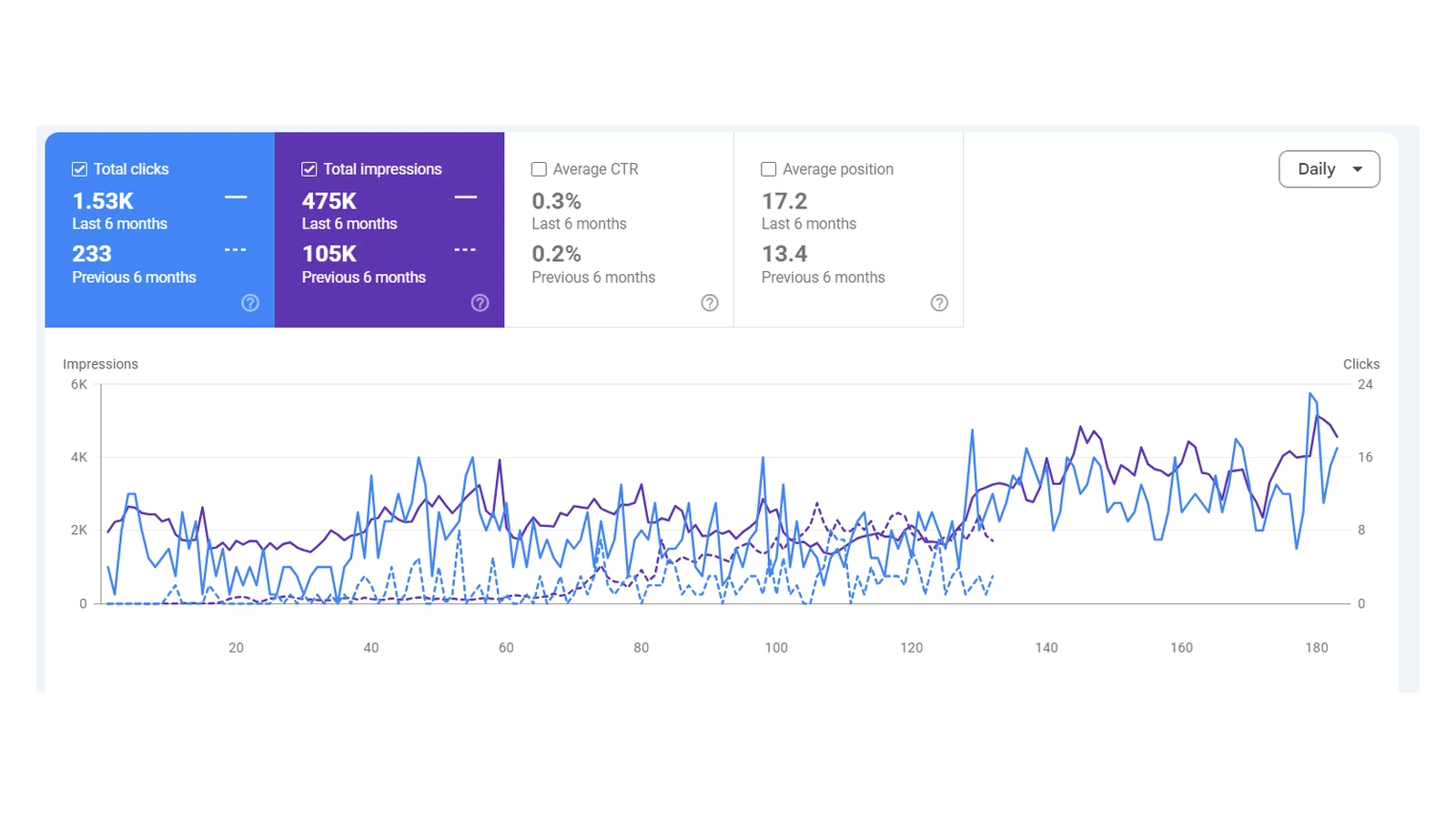
- A growing number of impressions in Search Console, which shows Google is testing your pages for more searches
- Rankings for specific, lower-competition searches, if you are lucky. When this happens early, it's great to show, but the chances are low.
If your provider can't tell you what they did each week, that is a bigger warning sign than slow rankings.
Why most SEO projects fail: stopping too early
The most common pattern we see isn't bad SEO. It's stopping too soon. A business starts SEO, spends money for a few months without leads, switches everything to paid ads and decides the agency was fooling them. Then the work that was about to pay off stops.
That is why we ask every client one question before starting: can you invest in SEO for around six months without expecting a return? If the answer is no, paid ads are a better place to start, and we say so. Our comparison of SEO vs Google Ads explains how to decide.
SEO is a game of patience. It builds slowly, and it keeps working long after the work stops, which is the point of doing it.
What can make it faster
- Fix technical problems first. If pages can't be crawled or indexed, nothing else counts. See our guide to technical SEO audit priorities.
- Start with specific searches. Specific, lower-competition searches rank sooner and bring early clicks while broader terms build up.
- Publish regularly. Consistent content over months builds more than a burst of pages followed by silence.
- Run ads alongside SEO if you need leads now. Ads bring inquiries while SEO builds.
FAQ
How long does SEO take to show results?
Impressions usually start within the first month, clicks within one to three months and strong, steady results in around eight to ten months. Local SEO can be faster, and new sites in crowded markets can take longer.
Why does a new website take longer to rank?
A new domain has no history or authority yet, so Google tests it slowly and sends few clicks at first. In crowded markets, it also competes with sites that have been publishing for years.
Can SEO show results in one month?
You can see impressions and sometimes a few clicks in the first month, especially for local or very specific searches. Steady leads in the first month are rare.
Is it better to start with SEO or ads?
If you can invest for around six months without expecting a return, start SEO. If you need leads now, start with ads and add SEO when you can. Many businesses run both.
What should an SEO agency report in the first three months?
What work was done each week, technical fixes completed, pages improved and growth in impressions. Rankings and leads may start in that period, but they shouldn't be the only measure yet.
Want to know how long SEO might take for your site? Our team can review it and give you an honest view of the starting point, the competition and a realistic timeline.