
Home improvement · Anonymous case study
Growing Organic Search Visibility for a Home Improvement E-commerce Business
An e-commerce and local SEO case study: an established home improvement business that sells online and installs locally grew its organic search presence across products, services and commercial search intent.
- Business
- Home improvement e-commerce business (name withheld)
- Market
- Products sold online, with installation in local service areas
- Measured
- Across the available Google Search Console comparison
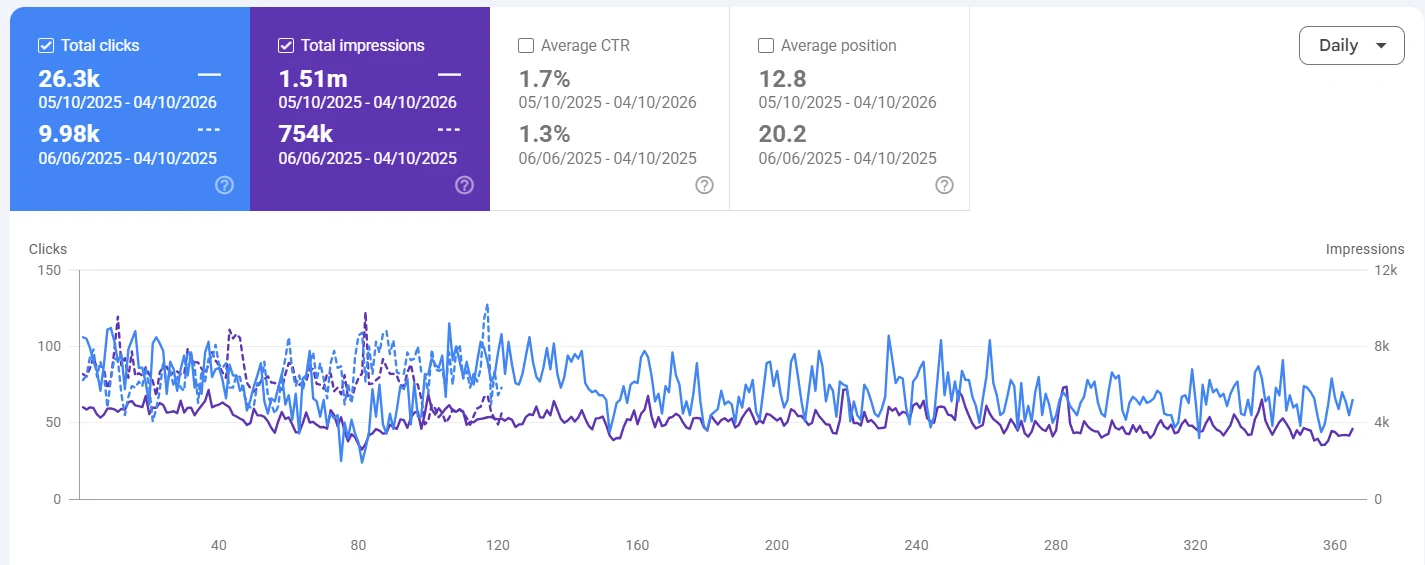
26.3K
Google Search Console clicks, 5 Oct 2025 to 4 Oct 2026.
1.51M
Search impressions over the same 12 months.
12.8
Improved from 20.2 in the earlier comparison period.
1.7%
Up from 1.3% in the earlier comparison period.
Source: Google Search Console. The business isn’t named. Clicks and impressions are totals for the current period; CTR and position are compared with 6 Jun 2025 to 4 Oct 2025.
Business context
A business that people search for in several ways
The business sells home improvement products, hardware and accessories online, installs them in its local service areas, and serves residential, commercial and industrial customers. So people reach it through several closely related kinds of search:
- Products: home improvement products, hardware and accessories
- Services: residential, commercial and industrial installation
- Solutions: product styles and options for homes, businesses and industrial sites
- Local intent: service and installation searches within the areas it serves
- Informational intent: questions about products, options and installation
That makes e-commerce local SEO harder than SEO for a single-category online store. The strategy had to cover every type of search without making the site confusing.
The starting point
Where we started: a broad search opportunity
The website already had an established presence. It operated across a wide product and service range, which created an opportunity to strengthen visibility across several layers of search intent at once: product and category searches, service searches, commercial and industrial searches, local searches and supporting informational searches.
The bigger problems were breadth and matching each page to the right intent. Traffic was a smaller concern.
The challenge
What needed to change
Match pages to search intent
Each page needed one clear job, matched to how people actually search.
Product and category relevance
Categories and products had to be clearly distinct and easy to understand.
Service-page visibility
Installation and service pages had to rank for service searches too, alongside the product pages.
Coverage across the range
Wider coverage across every product line and the different solutions on offer.
Relationships between pages
Products, categories, services and guides needed to link to each other sensibly.
Commercial and local demand
Commercial, industrial and local installation searches each needed the right page.
Organic authority
Authority to help all of it compete, built up steadily month by month.
Goals
What success looked like
- More search impressions and organic clicks
- A stronger average position
- A higher click-through rate
- Broader keyword visibility
- Visibility across product, service, local and informational intent
Revenue, leads and sales aren’t part of this case study because those figures weren’t provided. Only search metrics are reported.
The strategy
SEO built around products, services and search intent
Home improvement SEO can’t rest on one broad keyword category when a business both sells and installs. Someone searching for a specific product wants something different from someone looking for installation nearby, and both differ from a buyer comparing commercial options. Each page had to match the intent behind its searches.
- Products
- Categories
- Services
- Solutions
- Local intent
- Supporting content
- Internal linking
- Organic visibility
What we did
Seven workstreams
What was done, and why a business selling both products and services needed it.
Technical SEO
A large product and service site needs a structure search engines can crawl and understand consistently.
- Crawlability and indexability
- Site architecture
- Canonicalization
- Metadata
- Technical page quality
- Internal linking structure
On-page SEO
Pages were tuned to the intent behind their searches, so product, service and solution pages didn’t compete with each other.
- Title and meta description optimization
- Heading structure
- Page relevance and semantic coverage
- Search intent and commercial intent
E-commerce SEO
Product and category pages were treated as the commercial core, with a clear hierarchy between them.
- Category and product architecture
- Product search intent
- Category relevance
- Commercial queries
- Supporting content for categories
- Internal links between products and categories
Service and local SEO
Installation and service searches are usually local, practical and often urgent, so they need different pages from product searches.
- Service page optimization
- Installation intent
- Location-relevant search demand
- Local commercial intent
Content and blogs
Supporting content covered the questions people ask before buying or booking, and pointed them to the right product or service page.
- Home improvement products
- Product options and accessories
- Installation
- Commercial and residential projects
- Product selection
Internal linking
Pages were connected along the path a customer takes: category, product, service, then supporting content.
- Category
- Product
- Service
- Supporting content
Authority and off-page SEO
Authority building ran alongside the on-site work, focused on relevance to the industry and the market the business serves.
Search architecture
How the search demand was organized
Product intent
- Outdoor products
- Home products
- Hardware
- Accessories
Service intent
- Residential installation
- Commercial installation
- Industrial installation
Solution intent
- Residential solutions
- Commercial solutions
- Industrial solutions
- Custom projects
Local intent
- Location-specific services
- Local installation searches
Google Search Console
Organic search performance across the comparison
Current period: 5 Oct 2025 to 4 Oct 2026. Earlier comparison period: 6 Jun 2025 to 4 Oct 2025.
Analysis
What changed in organic search
- Average position: 20.2 → 12.8. An improvement of 7.4 positions. Because this is an average, it compares fairly across periods of different length.
- Average CTR: 1.3% → 1.7%. A larger share of impressions turned into clicks.
- 26.3K clicks and 1.51M impressions over the current 12-month period, showing the scale of the site’s organic presence.
- The two periods in this report are different lengths (12 months against about 4), so we don’t present the change in total clicks or impressions as growth. That needs an equal-length comparison.
Better position doesn’t mean every keyword reached page one, and none is claimed.
Semrush
Expanding organic keyword visibility
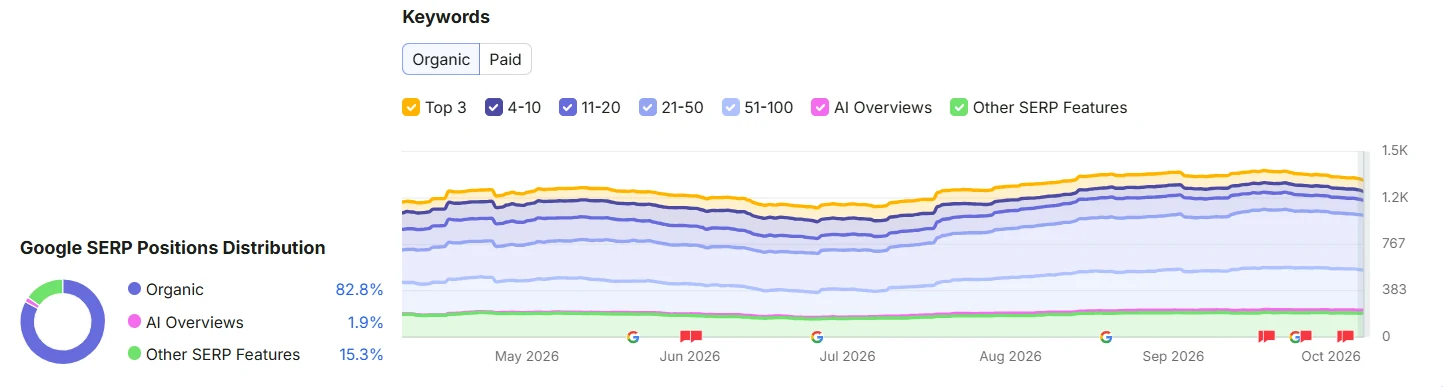
The site holds a large organic keyword footprint, on a chart that scales to 1.5K keywords, with the total edging up through the period and most growth in positions 4 to 20. The SERP position distribution shows organic listings at 82.8%, AI Overviews at 1.9% and other SERP features at 15.3%. Those are shares of tracked positions, not shares of traffic.
Market
SEO built around how local buyers search
Local SEO for e-commerce business models like this one starts with the words customers actually use. The strategy followed how local buyers search for products and gave extra weight to installation and service demand in the areas the business serves.
Before and after
Organic search performance, before and after
| Metric | Earlier period | Current period | Change |
|---|---|---|---|
| Average position | 20.2 | 12.8 | Improved by 7.4 positions |
| Average CTR | 1.3% | 1.7% | +0.4 points |
| Clicks (total) | 9.98K | 26.3K | Different period lengths |
| Impressions (total) | 754K | 1.51M | Different period lengths |
Source: Google Search Console. Comparison periods are the dates shown in the original report: 5 Oct 2025 to 4 Oct 2026 against 6 Jun 2025 to 4 Oct 2025. Because the periods differ in length, totals aren’t compared as growth.
The lesson
SEO has to match the way customers search
When a business sells products and also installs them, one keyword list won’t cover it. Product searches, service searches, local intent and informational queries each need their own kind of page.
The gains here came from linking those page types together in one site structure.
Services used
SEO services behind the growth
- Technical SEO
- E-commerce SEO
- Local SEO
- On-page SEO
- Content SEO
- Internal linking
- SEO consulting & strategy
- Off-page SEO
Related
Related SEO services
See also SEO for online stores or all case studies.
Is your website showing up when customers search?
Products, local services or both: SEO starts with how your customers search, then builds the right pages around that demand.